Aomori & Hirosaki itinerary: how to spend day one, and how to build from there
An efficient route through Aomori & Hirosaki with times attached. First-time visitors can use it exactly as written.
Contents
Aomori Prefecture sits at the northern tip of Honshu, three hours from Tokyo by shinkansen. It has three cores: Aomori City (the Nebuta festival and seafood), Hirosaki (a castle, cherry trees, and Meiji-era Western-style buildings), and Hakkoda/Oirase (mountains and a gorge). The three sit about an hour apart by car.
A one-day itinerary for Aomori & Hirosaki
| Time | Stop | What you do there |
|---|---|---|
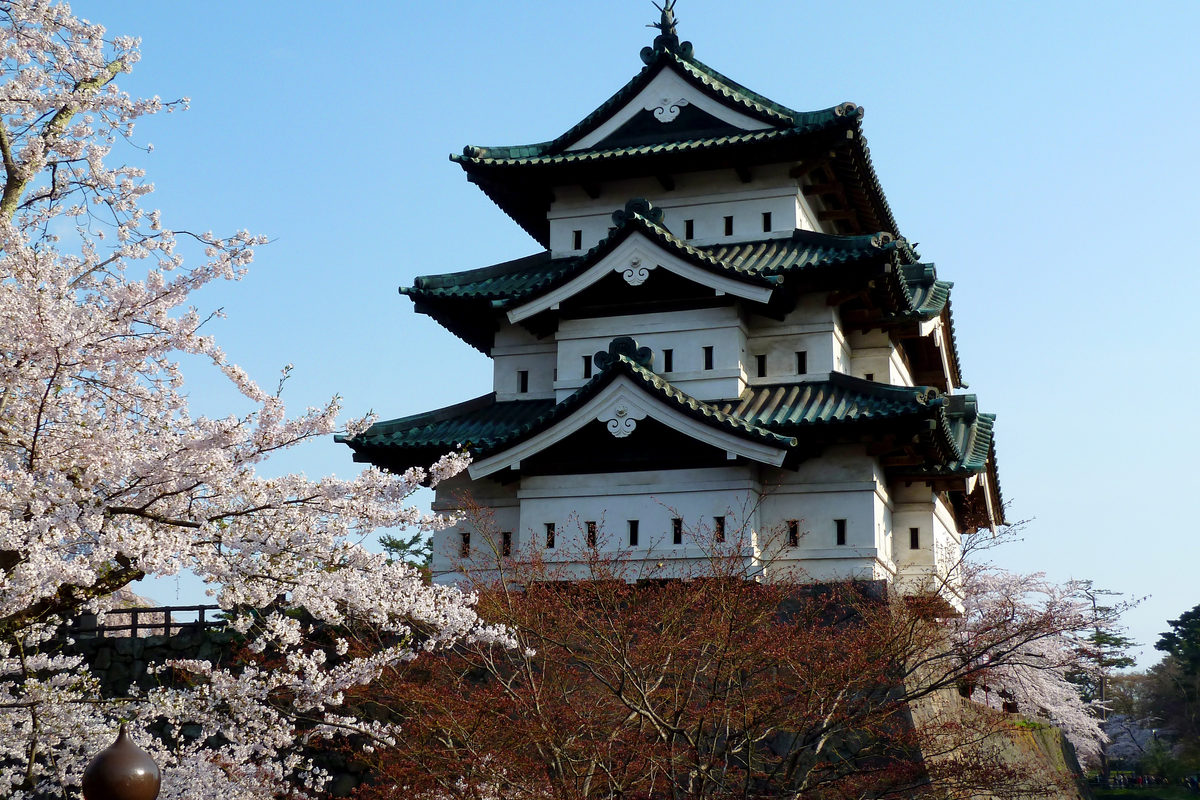
| 9:00 | Hirosaki Castle & Hirosaki Park | One of Japan’s 12 original keeps. Its 2,600 cherry trees are rated among the finest in the country, and the carpet of petals filling the moat is the signature sight |
| 10:30 | Hirosaki’s Western-style buildings | Meiji-era pseudo-Western architecture scattered through the town, from the former Fifty-Ninth Bank to the former Hirosaki City Library |
| 12:00 | Lunch in Hirosaki | Apple pie is the local specialty. Shops around town serve more than 50 different versions between them |
| 13:30 | Move on to Aomori City | About 40 minutes on the JR Ou Main Line |
| 14:30 | Nebuta Museum Wa Rasse | Full-size Nebuta floats on display year-round. The scale comes across even outside festival season |
| 16:00 | Aomori Museum of Art & Sannai-Maruyama site | Yoshitomo Nara’s Aomori-ken, plus a 5,900-year-old Jomon settlement that is a World Heritage site |
| 18:00 | Dinner at Furukawa Market | Nokkedon (a seafood bowl you build yourself) and local Aomori sake |
How to add day two and beyond
Day two takes you to Hakkoda and the Oirase Gorge. Oirase is a 14 km riverside trail. Walking all of it takes five hours, so most people ride the bus and pick a section to walk. Lake Towada sits upstream. On day three, choose the Tsugaru Peninsula (the Dazai Osamu house museum at Shayokan, and Cape Tappi) or Mount Osore on the Shimokita Peninsula. Osore is one of Japan’s three great sacred sites: hot springs bubbling up through a sulfurous wasteland, unlike anywhere else. In winter, it is Hakkoda’s snow-covered trees and skiing instead. What you come to Aomori for shifts sharply with the season.
If you only have half a day
With half a day, stick to Hirosaki: the castle, the Western-style buildings, and apple pie. Push on to Aomori City and travel time eats the day.
Frequently asked questions
Should I stay in Hirosaki or Aomori City?
Hirosaki during cherry-blossom season, Aomori City the rest of the year. Aomori City has better access to the shinkansen (Shin-Aomori) and the airport, plus more places to eat. Hirosaki has real castle-town atmosphere, but its restaurants close early.
Is the Nebuta festival worth planning around?
Yes. It runs only six days, August 2–7, but for scale and sheer energy it stands apart even among Japan’s summer festivals. Be aware that lodging starts selling out a year ahead and prices multiply.
Let us handle the arrangements
This route is based on the itineraries we actually hand to clients we book for Aomori & Hirosaki. We will rearrange it around your dates, energy level, and interests. Just ask.
See Aomori & Hirosaki tours Free consultation
Planning essentials for Aomori & Hirosaki
Beyond the main topic of this article, here is a summary of everything you need to plan a trip to Aomori & Hirosaki, with links to the full article on each subject.
Seasons and temperatures
| Season | Typical temperatures | Highlights and cautions |
|---|---|---|
| Spring (Apr–May) | 3–18°C | Hirosaki’s cherry blossoms peak in late April. In some years that overlaps with Golden Week, and the crowds are enormous |
| Summer (Jun–Aug) | 15–27°C | A short, cool summer. The Nebuta festival, August 2–7, is the main event |
| Autumn (Sep–Nov) | 6–22°C | Fall color at Oirase and Hakkoda from mid to late October. This is also apple harvest season |
| Winter (Dec–Mar) | -4–3°C | Some of the deepest snow in Honshu. Frost-covered trees at Hakkoda and the Sennin-buro bath at Sukayu |
Late April (Hirosaki cherry blossoms), early August (Nebuta), and mid to late October (fall color at Oirase and Hakkoda). Those three stand well above the rest. January through March, deep snow limits movement, but the winter landscapes at Sukayu and Hakkoda are unlike anything else in Japan. Clothing guidance and seasonal events are covered in the best time to visit Aomori & Hirosaki.
What to eat
- Oma tuna: Bluefin from the Tsugaru Strait, the catch that fetches record prices at Toyosu. Eating it where it lands costs a fraction of that
- Nokkedon: At Furukawa Market in Aomori City. Buy tickets, then have vendors lay your chosen toppings on the rice one at a time. Around ¥2,000
- Scallops: From Mutsu Bay. Raw, grilled, or as kaiyaki-miso, a local dish of egg and miso cooked in a scallop shell
- Apples: The top-producing prefecture in Japan, with more than 50 varieties. Peak season is September to November; apple juice is available year-round
- Apple pie: More than 50 versions across Hirosaki. The city publishes a guide map for comparing them
- Miso curry milk ramen: Aomori City’s local ramen. It tastes exactly like the name suggests, and it genuinely works
- Senbei-jiru: A Hachinohe specialty: nanbu senbei crackers broken into a hot pot
Lunch ¥1,000–2,000, dinner ¥3,000–6,000. Nokkedon runs ¥1,500–3,000 depending on what you pile on. A serious tuna meal will cost ¥8,000 or more, but seafood generally runs about half what it does in Tokyo. For where to find each dish, see what to eat in Aomori & Hirosaki.
Budget at a glance
Figure ¥40,000–55,000 per person for 3 days / 2 nights (roughly CA$400–550): ¥26,000 for two nights, ¥18,000 for three days of food, and ¥8,000 for transport and admissions. Add the round-trip shinkansen from Tokyo (around ¥35,000), which effectively disappears if you hold a nationwide JR Pass.
Hotel rates by class and the cuts that actually save money are detailed in the Aomori & Hirosaki budget guide.
Getting there
The Tohoku Shinkansen is the fastest way in: Tokyo to Shin-Aomori in as little as 2 hours 59 minutes. A nationwide JR Pass covers it at no extra charge, though Hayabusa trains are all-reserved, so you must claim a seat reservation.
| Route | Time | Notes |
|---|---|---|
| Tokyo → Shin-Aomori | About 3 hr | Tohoku Shinkansen Hayabusa, ¥17,670. One or two per hour. Covered by the JR Pass |
| Shin-Aomori → Aomori | About 6 min | JR Ou Main Line, ¥190. The shinkansen station sits a little outside the city center |
| Haneda → Aomori Airport | About 1 hr 20 min | Nonstop. Airport bus to the city takes 35 minutes, ¥750 |
| Aomori → Hirosaki | About 40 min | JR Ou Main Line, ¥670. One or two per hour |
| Aomori → Oirase & Lake Towada | About 2 hr | JR Bus Mizuumi-go. Some sections do not run in winter |
Local transport and the passes worth buying are covered in getting to Aomori & Hirosaki.
Good to know before you go
- Winter snowfall: Among the deepest in Honshu, with 50 cm possible overnight. Train delays and cancellations happen
- Falling roof snow: Even in central Hirosaki and Aomori, walking under eaves is risky
- Hakkoda in winter: The frost-covered trees are beautiful, but the weather turns violently. Backcountry without a guide is dangerous
- The Oirase trail: It runs alongside a road with live traffic. Walkers should stay alert at the shoulder
- Bear country: Hakkoda and the Shirakami mountains are Asian black bear habitat. Avoid hiking alone
- Nebuta crowds: August 2–7 brings road closures and heavy congestion. Allow double your usual travel time
- Mixed bathing at Sukayu: The Sennin-buro is traditionally mixed-gender, with women-only hours set aside
Etiquette and emergency contacts are covered in what to know before visiting Aomori & Hirosaki.
More frequently asked questions about Aomori & Hirosaki
How do I get a room during Nebuta?
Booking a year ahead is the realistic approach. If Aomori City is full, you can stay in Hirosaki or Hachinohe and commute in by train. We arrange this period every year, so talk to us early.
When do the Hirosaki cherry blossoms bloom?
Typically late April, about three weeks behind Tokyo. Peak bloom shifts by up to a week year to year, so we cannot promise a guaranteed viewing. That said, working your way north through Tohoku lets you chase the blossom front.
Can I eat Oma tuna in Aomori?
Yes, though Oma itself is Honshu’s northernmost point, three hours by car from Aomori City. Restaurants in the city do carry Oma-caught tuna. The season runs autumn into winter.
Can I take apples home?
Carrying fresh fruit across borders depends on the quarantine rules where you are headed. Both Canada and the US restrict it, so we suggest juice, jam, or other processed products as souvenirs instead.
Can I do this as a day trip from Tokyo?
The shinkansen takes three hours each way, so it is technically possible but leaves you only four or five hours on the ground. We recommend at least one night, preferably two.
Do I need a rental car?
Not for Aomori City, Hirosaki, and Hachinohe alone, since JR and buses cover those. For Hakkoda, Oirase, or the Shimokita Peninsula, you need a rental car or a coach tour.
Does the Hayabusa have unreserved seating?
No. Every car is reserved, so even with a JR Pass you must claim a seat reservation in advance. Reservations are free with the pass.
Can I reach Oirase by public transport?
JR buses run from Aomori and Hachinohe (mid-April to mid-November). Departures are limited, so check the timetable first if you want real walking time in the gorge. Service stops in winter.
Is winter worth it?
Yes. The frost-covered trees of Hakkoda, a snow-view bath at Sukayu, Hirosaki Castle buried in snow. Just plan around delays and add a spare day.
Can I take part in Nebuta as a haneto?
You can. Rent the costume (around ¥4,000) and you can join the line on the day. No advance registration is needed, and this is genuinely open to international visitors.

Plan this trip with IACE
Everything in this article is knowledge we use in real bookings every day. Tell us your dates, group size and interests, and we will turn it directly into your own itinerary.