Japan in September: the right-answer month nobody books
Typhoon risk starts falling, the crowds vanish, and up north the autumn leaves begin. September is the best-value month in Japan.
Contents
- What happens in September
- And up north, the autumn colours have already started
- A realistic approach to typhoons
- September temperatures (major cities)
- Where to go in September
- September is also the gateway to autumn eating
- A realistic approach to typhoons (the detailed version)
- How different are the prices?
- When to book
- A real September itinerary (7 days)
- What to wear and pack in September
- Early, mid and late month are three different months
- What to avoid in September
- How it stacks up against other months
- FAQ
What happens in September
Early in the month there is still summer heat and typhoon risk, but by late September the air changes. Domestic summer-holiday travellers are gone, and the autumn-leaves crowds have not yet arrived. Hotel rates run 30–40% below peak.
And up north, the autumn colours have already started
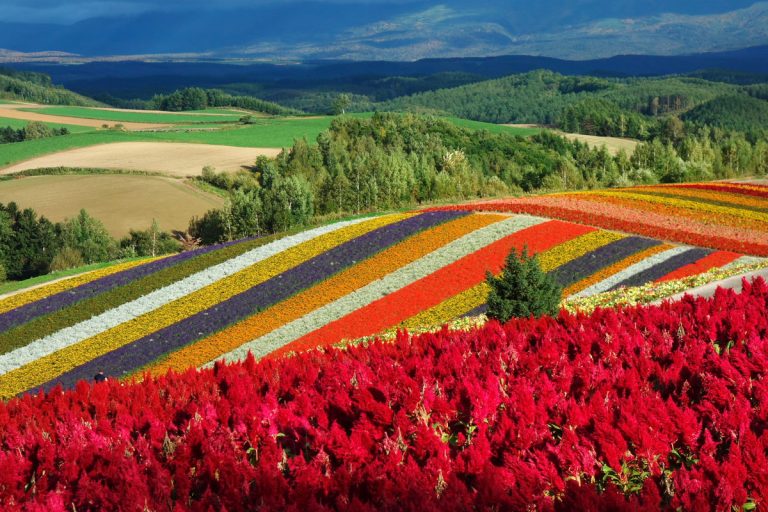
The first place in Japan to turn is the Daisetsuzan range in Hokkaido, in late September. Ride the Asahidake ropeway up and you see autumn brocade two months ahead of the main island.
A realistic approach to typhoons
Typhoons are forecast days in advance, and the railways suspend service on a planned schedule. They are less a danger than a lost day. Put one buffer day in your itinerary and carry travel insurance with cancellation coverage. That genuinely covers it.
September temperatures (major cities)
| City | Early Sep | Late Sep | In a word |
|---|---|---|---|
| Sapporo | 17–25°C | 12–20°C | Late month is autumn. Colours begin in the Daisetsuzan range |
| Tokyo | 24–31°C | 19–26°C | Early month is still hot; past the equinox it eases fast |
| Kyoto | 23–32°C | 18–27°C | The basin holds its heat. Temples in the morning and evening are the answer |
| Fukuoka | 24–31°C | 20–27°C | A month when typhoon tracks often pass this way |
| Naha | 27–32°C | 26–31°C | Still full summer. The sea is superb, but typhoon risk is at its highest |
Where to go in September
- Hokkaido: the first autumn colours on Daisetsuzan, and the autumn harvest. September Hokkaido is one of the most comfortable places in Japan.
- Nagano and Kamikochi: a quiet valley after the summer-hiking rush, as the air begins to clear.
- Kyoto: uncrowded temples at below-summer rates. Walk mornings and evenings and the lingering heat barely touches you.
- Tohoku: golden rice fields just before harvest, and onsen inns still easy to book ahead of leaf season.
September is also the gateway to autumn eating
September opens Japan’s season of appetite. New-crop rice reaches the shops, the sanma (Pacific saury) catch begins, and grapes (Shine Muscat and Kyoho) and nashi pears hit their peak. Hokkaido brings autumn salmon and ikura; Nagano, the first of the new soba. The famous autumn foliage waits until October, but autumn eating starts in September.
A realistic approach to typhoons (the detailed version)
To put the typhoon question in practical order:
- Typhoons do not appear out of nowhere. Tracks are forecast roughly 3–5 days out, and railways announce planned suspensions the day before landfall. You will have warning.
- The disruption usually clears in 1–2 days. A typhoon keeps moving; it will not sit over one place for three days.
- Build in one buffer day. Put an empty day late in the trip, ideally the day before your flight home, and a suspension gets absorbed.
- Insure it. Travel insurance with trip-change and cancellation coverage handles the hotel and transport losses a typhoon causes.
- On the day, do not fight it. Decide in advance that a planned-suspension day is a city indoor day of museums, department-store food halls and aquariums, and it is easier on the nerves too.
How different are the prices?
As a rule of thumb, hotel rates in mid-to-late September run 30–40% below the August peak and 20–30% below the autumn-foliage peak in late November. Airfares sit in the annual low band between the summer holidays and leaf season. If your criterion is “a good season at a good price,” late September to early October is the best-value window of the year.
When to book
A September trip is actually more relaxed to arrange than a summer one. Flights still have plenty of options 2–3 months out, and hotels can be chosen even a month ahead, apart from a few holiday dates. Compare that with Kyoto or Takayama in leaf season (late October onward), where the game is decided six months in advance. Put another way: for anyone thinking “I want Japan this year, but it is already summer,” September is the last good door still open. A best season you can still catch on short notice may be September’s greatest practical virtue.
A real September itinerary (7 days)
| Day | Plan | The idea |
|---|---|---|
| 1 | Arrive Tokyo. Asakusa and the Sumida River in the evening | Dodge the lingering heat by starting at dusk |
| 2 | Tokyo. Tsukiji and the Imperial Palace East Gardens in the morning, museums in the afternoon | Spend the hot hours indoors |
| 3 | Shinkansen to Kyoto. Higashiyama in the evening | An uncrowded Kyoto at below-summer rates |
| 4 | Kyoto. Fushimi Inari at 7 AM → a machiya cafe at midday → Arashiyama in the evening | The perfected morning-and-evening Kyoto |
| 5 | Fly to Sapporo | Here the trip switches to autumn |
| 6 | Asahidake ropeway for Japan’s earliest autumn colours | A brocade that exists only in late September |
| 7 | Seafood and miso ramen in Sapporo. Home from New Chitose | Close on the tastes of autumn |
Late summer on the main island plus the first of autumn in Hokkaido, in a single week. Only September allows that shape. Add one buffer day for an 8-day version and even a typhoon cannot rattle it.
What to wear and pack in September
- Clothing. Summer clothes as the base, plus one long-sleeved layer for late-month evenings and northern Japan. Early September in Kyoto and Tokyo is still full summer kit.
- A folding umbrella or rain jacket. This is also the autumn-rain-front season, and passing showers are routine.
- A light layer for indoors. Air conditioning is still on summer settings. Shinkansen cars and museums are chilled to the point of cold.
- Insect repellent. Mosquitoes are still active in gardens and on mountain paths.
Early, mid and late month are three different months
| Period | Conditions | Strategy |
|---|---|---|
| Early (1st–10th) | Peak lingering heat and typhoons. Effectively still August | Lean toward Hokkaido and Tohoku; on the main island, run a morning-and-evening schedule |
| Mid (11th–20th) | The air starts to turn. A holiday cluster gets domestic travellers moving | Book early only for the holiday dates. Daisetsuzan colours begin |
| Late (21st–30th) | Autumn reaches the main island; typhoon risk starts to fall | The best-value stretch of the year. Almost anywhere you go is the right answer |
What to avoid in September
- Building the trip around Okinawa and the islands: the risk of being stuck for 2–3 days by a typhoon peaks now. If you go, treat it as a bonus you could lose without pain.
- All-outdoor days: with lingering heat and passing showers, one indoor escape per day keeps the plan from collapsing.
- A long transfer the day before your flight home: a typhoon suspension hurts most right there. Spend the final night in your departure city.
- Expecting autumn leaves: the main island turns from mid-October. If you want colours in September, Daisetsuzan is the only answer.
How it stacks up against other months
For pure comfort, October to early November remains Japan’s best season. No argument there. September’s value is getting 90% of that comfort at 60–70% of the price and the crowds. Cherry blossom (late March–April) and peak foliage (mid-to-late November) win on beauty, but cost nearly twice as much and are booked months out. Measured by value for money, late September to early October is the top of the year. That is the honest verdict from the booking desk.
Availability in this window is genuinely good, so even last-minute consultations usually come together.
FAQ
Is the September holiday cluster (Silver Week) crowded?
The days around Respect for the Aged Day and the autumn equinox are Japanese holidays, and domestic travellers do move. But it is nothing like Golden Week, and rooms do not sell out wholesale. Skip just those few days and the month gets even more comfortable.
What about Okinawa and the beaches?
The sea is at its best, but typhoon risk is the highest of the year. If you go, build in slack and carry insurance with cancellation coverage. Tacking Okinawa onto a main-island trip is a slightly bad bet in September.
Is September too early for autumn leaves?
On the main island, yes, since colours start from mid-October. The one exception is Hokkaido’s Daisetsuzan range, which begins turning in mid-September, the earliest in Japan. The Asahidake ropeway is the easiest way up.

Plan this trip with IACE
Everything in this article is knowledge we use in real bookings every day. Tell us your dates, group size and interests, and we will turn it directly into your own itinerary.