Fuji Five Lakes & Kawaguchiko itinerary: how to spend day one, and how to build from there
An efficient route through Fuji Five Lakes & Kawaguchiko with times attached. First-time visitors can use it exactly as written.
Contents
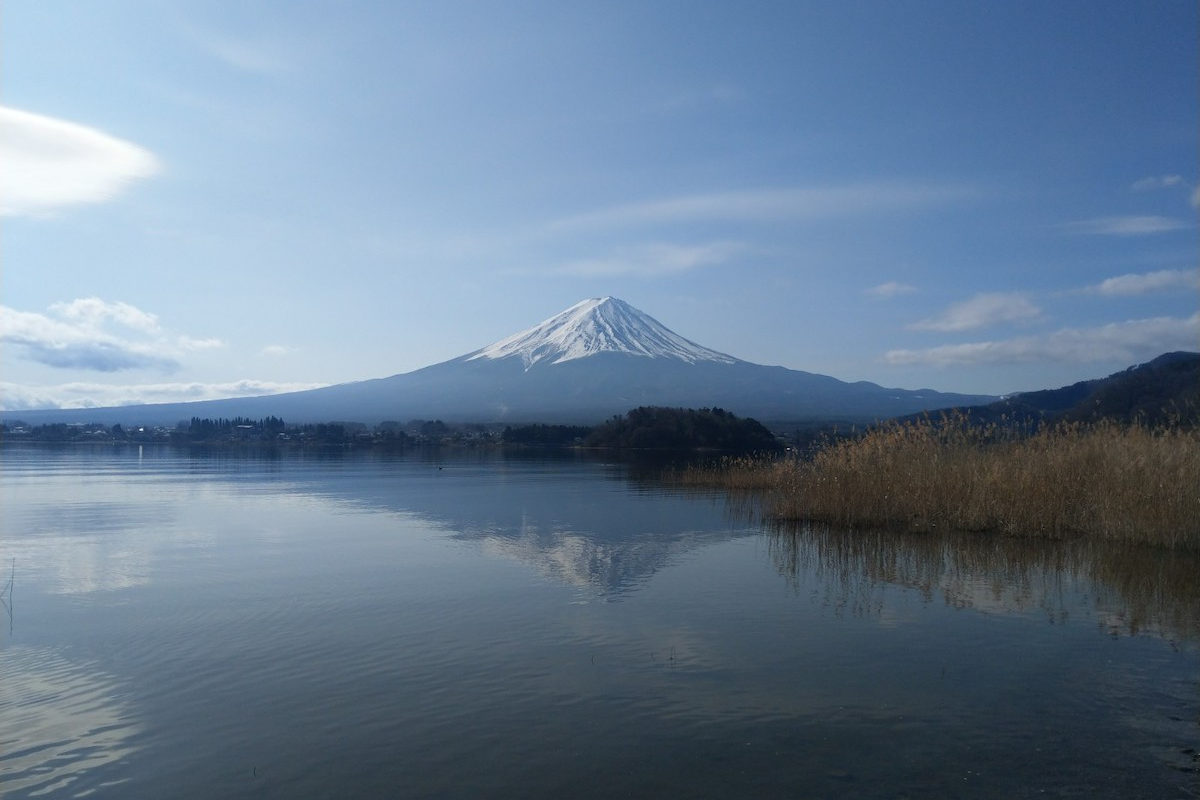
If you want to SEE Mt. Fuji, go to the Fuji Five Lakes on the north side. If you want to CLIMB it, you have a two-month window in summer. These are two completely different trips. Kawaguchiko is just 1 hour 45 minutes from Tokyo by highway bus, making it the most practical base for viewing Fuji head-on.
A one-day itinerary for Fuji Five Lakes & Kawaguchiko
| Time | Stop | What you do there |
|---|---|---|
| 8:30 | Highway bus from Shinjuku | 1 hour 45 minutes to Kawaguchiko, around ¥2,200. Direct from the Busta Shinjuku terminal |
| 10:30 | Oishi Park on Lake Kawaguchi | Mt. Fuji across the lake. Lavender in June–July, kochia bushes in autumn frame the view |
| 11:30 | Kawaguchiko Tenjozan Ropeway | Three minutes up to 1,075 m. You look down on the lake and Fuji at the same time |
| 12:30 | Lunch by Lake Kawaguchi | Try hoto, thick miso-stewed noodles with pumpkin, the local dish of Yamanashi |
| 14:00 | Arakurayama Sengen Park (Shimoyoshida) | The world-famous shot of pagoda, cherry blossoms, and Fuji in one frame. You climb 398 steps |
| 15:30 | Oshino Hakkai | Eight ponds fed by Fuji spring water. The clarity is unreal |
| 17:00 | Check in at Kawaguchiko | Lakeside inns offer Fuji-view rooms. The point is Fuji at dusk and again at dawn |
How to add day two and beyond
On day 2, the classic move is to drive around the five lakes: Lake Yamanaka (swans and Diamond Fuji), Lake Motosu (the Fuji composition on the ¥1,000 bill), and Lake Shoji. Alternatives are Fuji-Q Highland (an amusement park famous for extreme coasters) or the Fuji Subaru Line 5th Station (2,300 m, reachable by car). In July–August, climbing to the summit is also an option. On day 3, continuing to Hakone lets you see Fuji from the east side as well. Fuji and Hakone are the most natural pairing for a trip out of Tokyo.
If you only have half a day
With half a day, pick one of Oishi Park or Arakurayama Sengen Park, plus Oshino Hakkai. The top priority is seeing Fuji on a day it is actually visible. On a cloudy day, do not force a lake circuit; switch to indoor sights instead.
Frequently asked questions
What are the odds of actually seeing Mt. Fuji?
In our experience, roughly 70 percent in winter (December–February) and only 20–30 percent in summer (July–August). Mornings are better; clouds tend to build in the afternoon. Plan on the assumption that a clear view is a stroke of luck.
Can I climb Mt. Fuji?
The climbing season is only about two months, roughly early July to early September. Outside that window the trails are closed, and attempting the climb without proper gear is dangerous. The standard plan is an overnight in a mountain hut, and we offer guided summit tours both in season and off season.
Let us handle the arrangements
This route is based on the itineraries we actually hand to clients we book for Fuji Five Lakes & Kawaguchiko. We will rearrange it around your dates, energy level, and interests. Just ask.
See Mt. Fuji & Kawaguchiko tours Free consultation
Planning essentials for Fuji Five Lakes & Kawaguchiko
Beyond the main topic of this article, here is a summary of everything you need to plan a trip to Fuji Five Lakes & Kawaguchiko, with links to the full article on each subject.
Seasons and temperatures
| Season | Typical temperatures | Highlights and cautions |
|---|---|---|
| Spring (Apr–May) | 3–19C | Cherry blossoms in mid April. The pagoda, blossoms, and Fuji at Arakurayama Sengen Park line up for only these two weeks |
| Summer (Jun–Aug) | 14–27C | Comfortable as a summer retreat, but Fuji often hides in cloud. July–August is climbing season |
| Autumn (Sep–Nov) | 5–22C | Foliage peaks early to mid November. The Momiji Corridor at Kawaguchiko. The air begins to clear |
| Winter (Dec–Mar) | -6–8C | The best season for seeing Fuji. Snow-capped views and crisp, freezing air |
November through February is best for seeing Fuji: clear air and a snow-capped peak. Mid April (cherry blossoms, pagoda, and Fuji) is the most famous photo combination, but those two weeks are extremely crowded. Think of July–August as a season that exists purely for climbing. Clothing guidance and seasonal events are covered in the best time to visit Fuji Five Lakes & Kawaguchiko.
What to eat
- Hoto: Flat noodles simmered in miso with pumpkin and vegetables, the signature dish of Yamanashi. ¥1,200–1,800 per serving
- Yoshida udon: Extra-thick, extra-firm udon from Fujiyoshida, topped with horse meat and cabbage. Cheap at ¥600–900
- Fuji spring water: The waters of Oshino Hakkai and Shiraito Falls. Some visitors bottle it to take home
- Koshu wine: Centered on Katsunuma. Koshu is a grape variety native to Japan, making white wines that pair well with Japanese food
- Shingen mochi: Rice cakes served with kinako soy flour and black sugar syrup: the classic Yamanashi souvenir
- Fuji-shaped breads and sweets: Souvenir shops are full of pastries shaped like the mountain
- Game meat: Some restaurants in the hills serve venison and wild boar
Lunch ¥1,000–2,000; dinner, including inn meals, ¥4,000–8,000. Yoshida udon is remarkably cheap at around ¥600, hoto around ¥1,500. Reasonable pricing for a major tourist area. For where to find each dish, see what to eat in Fuji Five Lakes & Kawaguchiko.
Budget at a glance
A one-night, two-day trip from Tokyo runs ¥30,000–45,000 per person (roughly CA$300–450): round-trip highway bus ¥4,400, one night ¥20,000, food ¥8,000, and ¥5,000 for local transport and admissions. A Fuji-view room pushes the hotel cost to around ¥30,000.
Hotel rates by class and the cuts that actually save money are detailed in the Fuji Five Lakes & Kawaguchiko budget guide.
Getting there
The fastest, cheapest, simplest way to the Fuji Five Lakes is the highway bus from Shinjuku. By rail, take the JR Chuo line to Otsuki and transfer to the Fujikyu Railway. Note that the nationwide JR Pass does not cover the Fujikyu line, which is not a JR line.
| Route | Time | Notes |
|---|---|---|
| Shinjuku → Kawaguchiko | approx. 1 hr 45 min | Highway bus, around ¥2,200. 1–2 departures per hour. The most convenient route |
| Shinjuku → Kawaguchiko (rail) | approx. 2 hr | JR Chuo line limited express to Otsuki, transfer to Fujikyu Railway, around ¥4,000 |
| Tokyo → Mishima | approx. 50 min | Tokaido Shinkansen, the approach from the south side of Fuji. Covered by the JR Pass |
| Kawaguchiko → Oshino Hakkai | approx. 25 min | Local bus, ¥750 |
| Kawaguchiko → Lake Yamanaka | approx. 35 min | Local bus, ¥750 |
Local transport and the passes worth buying are covered in getting to Fuji Five Lakes & Kawaguchiko.
Good to know before you go
- Off-season climbing: Trails are closed mid September through June. The mountain becomes snow and ice, and people have died attempting it
- Bullet climbing: Climbing through the night for sunrise carries high risks of altitude sickness and exhaustion. Local authorities actively discourage it
- Altitude sickness: Ascending straight from the 5th Station brings it on. Spend 1–2 hours acclimatizing at the 5th Station first
- Climbing restrictions: The Yoshida trail has an entry fee and a daily cap on climbers (as of August 2026)
- The steps at Arakurayama Sengen Park: 398 of them. At peak times lines form and the descent backs up
- Lakeside winds: Lakes Yamanaka and Kawaguchi get strong winds some days. Boats stop running
- Winter road ice: High altitude means sub-zero mornings and evenings. Driving on summer tires is dangerous
Etiquette and emergency contacts are covered in what to know before visiting Fuji Five Lakes & Kawaguchiko.
More frequently asked questions about Fuji Five Lakes & Kawaguchiko
Can I see cherry blossoms and Mt. Fuji together?
For about two weeks in mid April. Arakurayama Sengen Park has the most famous composition, but expect long lines on the steps at that time. Bloom dates shift by about a week from year to year, so it cannot be guaranteed.
What is Diamond Fuji?
It is the moment the sun aligns with the summit of Fuji, and the locations and dates are mathematically fixed. Early February at Lake Yamanaka; April and August at Lake Motosu. We can plan an itinerary working backward from those dates.
Where can I eat Yoshida udon?
There are dozens of shops in Fujiyoshida, but many operate out of private homes, lunch only, closing by 1–2 PM. The city publishes an udon map, and following it is the reliable way to find them.
Can I visit the wineries?
Katsunuma has more than 30 wineries offering tours and tastings, about an hour by car from Kawaguchiko. Since tastings are involved, the driver cannot drink, so we can arrange a private car with driver.
Is a Fuji-view room worth the premium?
In the clear season (November–February), yes. Waking up to a snow-capped Fuji framed in your window is worth the difference. In summer the odds of seeing it are low, so the premium buys much less.
Can I do this as a day trip from Tokyo?
Yes. The bus round trip takes 3.5 hours total, leaving you 7–8 hours on the ground. But if you want Fuji at dusk and dawn, the best times, you need to stay the night.
Can I reach Mt. Fuji with the JR Pass?
The pass covers the JR Chuo line as far as Otsuki, but the Fujikyu line from there to Kawaguchiko is extra (around ¥1,170). There is also a route via Mishima to the south side of Fuji, but the views are quite different from the Kawaguchiko side.
Can I drive to the Fuji 5th Station?
The Fuji Subaru Line toll road climbs to 2,300 m. During the summer climbing season, however, private cars are banned and only shuttle buses run. The road closes in winter.
Can a beginner climb Mt. Fuji?
With reasonable fitness, yes, but do not underestimate a 3,776 m mountain. The standard approach is an overnight in a mountain hut, acclimatizing as you go. All-night bullet climbs cause accidents, and local authorities discourage them.
Can I climb outside summer?
The trails are closed, and the huts and first-aid stations are shut. The mountain becomes a serious snow-and-ice climb. We do handle off-season ascents, but only as guided tours for experienced climbers.

Plan this trip with IACE
Everything in this article is knowledge we use in real bookings every day. Tell us your dates, group size and interests, and we will turn it directly into your own itinerary.