What to eat in Shirakawa-go & Gokayama: local specialties and where to find them
The dishes Shirakawa-go & Gokayama is known for, and places to eat that fit naturally between the sights. Budget guidance included.
Contents
The food of Shirakawa-go and Gokayama is what a deep-snow region preserves and what the mountains give: salted wild vegetables, river fish, and doburoku. This is one of the few places where brewing doburoku is specially permitted, for shrine rites.
What to eat in Shirakawa-go & Gokayama
| Dish | What it is and where to try it |
|---|---|
| Doburoku | Cloudy unfiltered sake. Shirakawa-go is licensed to brew it for the shrine festivals |
| Hoba miso | Miso and mountain vegetables grilled on a magnolia leaf, the home dish of Hida and Shirakawa-go |
| Grilled iwana and ayu | River fish skewered and grilled at the hearth. A staple of the gassho minshuku table |
| Mountain vegetables | Kogomi, zenmai, warabi. Spring greens, and the salted preserves made from them |
| Gohei-mochi | Mashed rice pressed onto a skewer and grilled with miso glaze |
| Soba | Mountain soba, served at the eateries inside the villages |
| Hida beef | Shirakawa-go is in Gifu Prefecture, and several places serve Hida beef |
Where to eat
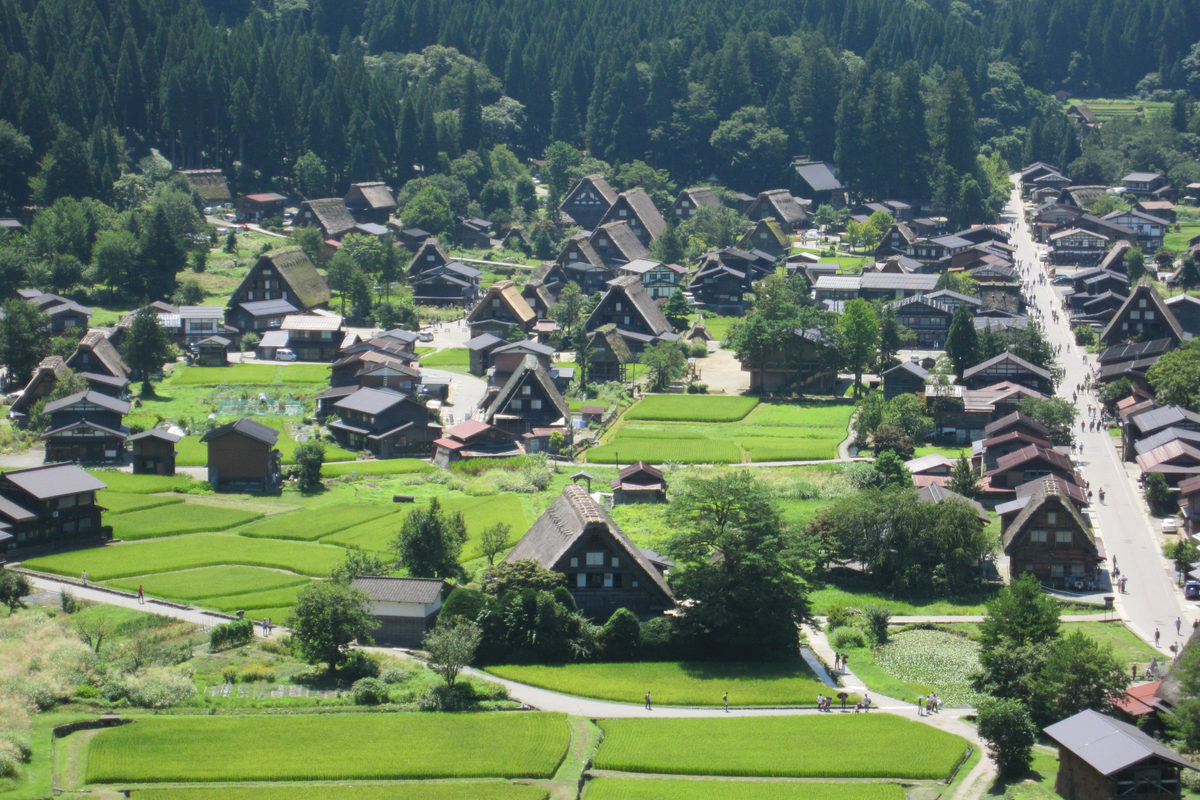
Shirakawa-go has around ten eateries and sweet shops inside the village, all small and all closing at 16:00–17:00. Gokayama has fewer still, only a handful each in Suganuma and Ainokura. If you stay at a gassho minshuku, dinner around the irori hearth is the central experience. On a day trip, shifting lunch to before noon or after 13:30 avoids the wait.
What meals cost
Lunch ¥1,200–2,500. A gassho minshuku runs ¥12,000–20,000 with two meals. Minshuku food is mountain vegetables and river fish, and the portions are ample.
Frequently asked questions
Can I drink doburoku?
It is served at the Shirakawa-go doburoku festival in mid October. At other times, some village restaurants and souvenir shops sell bottled versions. The alcohol content is on the high side, so start small.
What is dinner like at a gassho minshuku?
Around the hearth: small dishes of mountain vegetables, salt-grilled river fish, hoba miso, local produce. Nothing showy. It is simply the food of this place.
Let us handle the arrangements
If you have dietary needs, whether allergies, vegetarian or halal, we confirm them with each restaurant in Japanese when we book. Having foods you cannot eat is no reason to narrow your trip.
See Shirakawa-go & Gokayama tours Free consultation
Planning essentials for Shirakawa-go & Gokayama
Beyond the main topic of this article, here is a summary of everything you need to plan a trip to Shirakawa-go & Gokayama, with links to the full article on each subject.
A one-day route at a glance
9:00 Shirakawa-go (Ogimachi gassho village) → 9:30 The Wada House → 10:30 Shiroyama Tenshukaku viewpoint → 11:30 Myozenji temple and folk museum → 12:30 Lunch in the village → 14:00 On to Gokayama → 15:00 Suganuma → 16:00 Ainokura → 17:30 To Takaoka or Kanazawa
Shirakawa-go alone takes 3–4 hours on foot: viewpoint, village, the Wada House, lunch. Add Gokayama and it becomes a full day.
Extending beyond day one
Staying in a gassho-zukuri minshuku in Shirakawa-go or Gokayama changes the character of the visit entirely: dinner of mountain vegetables and river fish around the irori hearth, then the silent village after the day-trippers have gone. Rooms are so few that booking six months out is the realistic timeline. On day 2, the natural move is Takayama (the old town) or Kanazawa (Kenrokuen and the teahouse districts). The winter light-ups (set dates in January–February) are reservation-only and among the hardest tourist events in Japan to get into. For the full timed itinerary, see the Shirakawa-go & Gokayama itinerary.
Seasons and temperatures
| Season | Typical temperatures | Highlights and cautions |
|---|---|---|
| Spring (Apr–May) | 2–21C | Snowmelt and rice planting. From late April, the flooded paddies mirror the gassho houses |
| Summer (Jun–Aug) | 18–30C | Deep green, with the rice growing. Muggy in the valley but cool at either end of the day |
| Autumn (Oct–Nov) | 4–21C | Foliage and the rice harvest. Late October to early November is the most beautiful stretch |
| Winter (Dec–Mar) | -4–4C | Over 2 m of snow. The January–February light-ups are reservation-only |
Late October to early November (foliage and harvest) and May (new green and the mirrored paddies). The winter snowscape is overwhelming, but light-up reservations are extremely hard to get. Even on an ordinary winter weekday without the light-up, the buried village is well worth seeing. Clothing guidance and seasonal events are covered in the best time to visit Shirakawa-go & Gokayama.
Budget at a glance
A day trip from Takayama runs ¥9,000–13,000 per person (roughly CA$90–130): bus round trip ¥5,200, admissions ¥1,000, lunch ¥2,000, souvenirs ¥2,000. Staying at a gassho minshuku adds about ¥15,000.
Hotel rates by class and the cuts that actually save money are detailed in the Shirakawa-go & Gokayama budget guide.
Getting there
Buses reach Shirakawa-go from Takayama, Kanazawa, and Toyama. There is no railway station. For Gokayama, take a bus from Shirakawa-go, or the Nanto city bus from Johana or Takaoka.
| Route | Time | Notes |
|---|---|---|
| Takayama → Shirakawa-go | approx. 50 min | Nohi Bus, ¥2,600. Some services require reservations |
| Kanazawa → Shirakawa-go | approx. 1 hr 15 min | Hokutetsu and Nohi Bus, around ¥2,000. Reservation required |
| Toyama → Shirakawa-go | approx. 1 hr 25 min | Kaetsunou Bus, around ¥1,700 |
| Nagoya → Shirakawa-go | approx. 3 hr | Direct Gifu Bus highway service, around ¥4,000 |
| Shirakawa-go → Gokayama (Ainokura) | approx. 30 min | Kaetsunou Bus, around ¥1,000 |
Local transport and the passes worth buying are covered in getting to Shirakawa-go & Gokayama.
Good to know before you go
- The village is someone’s home: Most gassho houses are lived in. Entering yards or gardens is prohibited
- No drones: Drone flights are banned in Shirakawa-go
- Stay out of the fields: The paddies and plots are working farmland. People walking into them for photos has become a problem
- No open flame: Thatched roofs burn easily. Smoke only in designated areas
- Winter snow and roof slides: Over 2 m of snow. Snow sliding off roofs is dangerous, so do not walk under the eaves
- Parking fills up: In the foliage season and on long weekends, the lots are full by late morning
- Bear country: The surrounding forest is Asian black bear habitat
Etiquette and emergency contacts are covered in what to know before visiting Shirakawa-go & Gokayama.
More frequently asked questions about Shirakawa-go & Gokayama
Should I visit Shirakawa-go or Gokayama?
Shirakawa-go for scale and facilities; Gokayama for quiet and authenticity. Shirakawa-go takes two million visitors a year and is very crowded in peak season. Suganuma in Gokayama has just nine houses and far fewer people. If you have the time, we recommend both.
Can I see the light-ups?
They run on set dates in January and February, about six evenings a year, and are entirely reservation-based. Entry to the viewpoint is by lottery as well. Demand vastly exceeds supply, so if you want to be sure of seeing them, talk to us from the autumn of the year before.
How do I book the light-up?
Applications typically open in the autumn of the previous year, with separate allocations for overnight guests and for day-trip bus tours. Entry to the viewpoint is a separate lottery again. We take enquiries from the year before.
Is winter difficult?
Roads are cleared, but buses run late on heavy snow days, and the village paths narrow under the drifts. Even so, the buried gassho houses are the most famous image Shirakawa-go has.
Is staying at a gassho minshuku worth it?
Very much so. Once the day visitors leave, the village goes remarkably quiet, and the meal at the hearth and the morning mist on the gassho roofs belong to overnight guests alone. But rooms are extremely limited, and six months ahead is the realistic booking window.
What does Shirakawa-go cost to enter?
There is no admission charge for the village itself. You pay only for parking (around ¥1,000) and to go inside the houses (¥300–400 each).
Do I need bus reservations?
Some Takayama–Shirakawa-go and Kanazawa–Shirakawa-go services are reservation-only. In the foliage season and during the winter light-ups they sell out, so we strongly recommend booking ahead.
Can I drive there?
Yes, but you cannot park in the village. You leave the car across the river (around ¥1,000) and walk over the bridge. In winter the roads are snow-covered and winter tyres are mandatory.
Can I take photographs?
From the streets and the viewpoint, freely. But avoid photographing inside private grounds, residents themselves, or their daily life without permission. Drones are banned.
Is winter dangerous?
Not dangerous, but heavy snow can delay or cancel buses. Bring waterproof winter boots and leave room in your schedule.

Plan this trip with IACE
Everything in this article is knowledge we use in real bookings every day. Tell us your dates, group size and interests, and we will turn it directly into your own itinerary.