Best time to visit Nakasendo (Tsumago & Magome): temperatures, crowds, and what to wear by month
When should you go? An honest look at Nakasendo (Tsumago & Magome) in every season, covering temperatures, highlights, and the times we would avoid.
Contents
The Kiso Valley runs 400–900 m in elevation: cool summers, snowy winters. The pass trail changes character with the seasons, and the fresh green of spring and the autumn foliage are the standouts. Winter snow makes the walking harder, but the snow-covered post towns are worth seeing in their own right.
Temperatures and highlights by season
| Season | Typical temperatures | Highlights and cautions |
|---|---|---|
| Spring (Apr–May) | 4–21C | Cherry blossoms mid April. May, with new leaves on the pass trail, is the most pleasant walking |
| Summer (Jun–Aug) | 17–29C | The valley stays cool but midday is hot. The trail is well shaded |
| Autumn (Oct–Nov) | 5–21C | Foliage late October to early November, the high season for walking the Nakasendo |
| Winter (Dec–Mar) | -4–7C | Snow on the ground. The pass is walkable with proper footwear, and the snowy towns are quiet and beautiful |
What to wear
This is a walking trip, so shoes matter most. The trail mixes stone paving and dirt, slippery after rain, so wear trekking shoes or grippy sneakers. Even in summer the valley cools off, so bring a layer for mornings and evenings. Winter means snow and ice; footwear with real traction is essential. The plan assumes your luggage goes ahead by courier, so carry only a daypack on walking days.
So when should you actually go?
Late April to June (fresh greenery) and late October to early November (foliage) are the two best walking windows. Summer is hot but well shaded; winter offers the different charm of snowbound post towns. During the rainy season (late June to mid July) the trail gets slick.
Events worth timing your trip around
- Mid April: Cherry blossoms. The towns themselves have few trees, but the wild mountain cherries around them are lovely
- May: Fresh greenery, and the finest month for walking the Nakasendo
- August: Tsumago summer festival. The Edo-period costume procession is in November
- Late October–early November: Foliage: the pass trail at its best
- November 23: The Bunka-Bunsei costume procession in Tsumago, a parade in Edo-period dress through the town
Frequently asked questions
Can I walk it in winter?
Yes, but there is snow and ice. Shoes with traction are essential, and with early sunsets, start walking by 2 PM. Snowy Tsumago has few visitors and is quiet and lovely.
What if it rains?
The trail is walkable in rain, but the stone paving gets slippery. A rain jacket and grippy shoes see you through. If conditions are bad, the bus between Magome and Tsumago (about 25 minutes) is the fallback.
Let us handle the arrangements
If you already know when you want to travel, we can rebuild the schedule around the days when crowds and prices spike. Temperatures and crowd patterns shift a little every year, so contacting us 3–4 months before departure gives you the most options.
See the Nakasendo Kiso Valley day tour Free consultation
Planning essentials for Nakasendo (Tsumago & Magome)
Beyond the main topic of this article, here is a summary of everything you need to plan a trip to Nakasendo (Tsumago & Magome), with links to the full article on each subject.
A one-day route at a glance
9:30 Magome-juku → 10:30 Climb toward Magome Pass → 11:30 Magome Pass (801 m) → 12:30 Odaki and Medaki falls → 13:30 Tsumago-juku → 14:30 Wakihonjin Okuya and Tsumago Honjin → 16:00 Gohei-mochi break → 17:00 To Nagiso station
With half a day, walk just one town, either Tsumago or Magome. The pass crossing takes 2–3 hours one way, so it does not fit in half a day. A bus links the two towns as an alternative.
Extending beyond day one
For a proper walking trip, start from Narai-juku and take two to three days. Narai is the longest post town in Japan (about 1 km) and the largest of the eleven Kiso towns. Walking Narai → Yabuhara (over the Torii Pass) → Fukushima → Tsumago → Magome takes you through the heart of the Nakasendo. Each town has family-run inns, and luggage can go ahead by takkyubin (luggage delivery). On rest days, visit the checkpoint ruins at Kiso-Fukushima or the Akasawa forest railway. For the full timed itinerary, see the Nakasendo (Tsumago & Magome) itinerary.
What to eat
- Gohei-mochi: Mashed rice pressed onto a skewer, brushed with walnut miso, and grilled over charcoal. ¥200–400 each
- Kiso soba: Mountain soba. The local variation is sunki-soba, topped with sunki, a salt-free fermented pickle unique to Kiso
- Hoba-maki: Sweet rice dumplings wrapped in magnolia leaves and steamed, an early-summer Kiso tradition
- Grilled iwana and ayu: River fish from the Kiso River, charcoal-grilled at post-town restaurants
- Kuri-kinton: The autumn specialty of Nakatsugawa, next to Magome: a confection of chestnuts and sugar, nothing else
- Sunki pickles: Red turnip greens fermented without any salt, a preserve found only in Kiso
- Gohei-mochi and oyaki snacks: Light bites descended from the packable food of highway travelers
Lunch ¥1,000–1,800, gohei-mochi around ¥300. A minshuku night with two meals runs ¥10,000–16,000. The Kiso Valley is remarkably cheap by Japanese tourism standards, and the cooking is honest home fare. For where to find each dish, see what to eat in Nakasendo (Tsumago & Magome).
Budget at a glance
One night, two days: ¥20,000–30,000 per person (roughly CA$200–300). Minshuku with two meals ¥13,000, transport ¥5,000, luggage forwarding ¥1,000, admissions ¥1,000, lunch ¥1,500. Among Japan’s major destinations, this is one of the cheapest deep experiences you can buy.
Hotel rates by class and the cuts that actually save money are detailed in the Nakasendo (Tsumago & Magome) budget guide.
Getting there
The Nakasendo post towns are reached from Nagoya on the JR Chuo line. Magome is a bus ride from Nakatsugawa station, Tsumago from Nagiso station; at Narai, the station opens straight onto the town. The line is covered by the nationwide JR Pass.
| Route | Time | Notes |
|---|---|---|
| Nagoya → Nakatsugawa | approx. 1 hr 20 min | JR Chuo line rapid, ¥1,340. Or 50 min by Shinano limited express, around ¥3,000 |
| Nakatsugawa station → Magome | approx. 25 min | Kita-Ena bus, ¥580. One bus every 1–2 hours |
| Nagoya → Nagiso | approx. 1 hr 45 min | JR Chuo line, ¥1,690 |
| Nagiso station → Tsumago | approx. 10 min | Ontake Kotsu bus, ¥300 |
| Magome ⇄ Tsumago | approx. 25 min | Bus, around ¥800, the option if you are not walking |
Local transport and the passes worth buying are covered in getting to Nakasendo (Tsumago & Magome).
Good to know before you go
- Asian black bears: The pass trail runs through bear habitat. Bear bells are mounted along the path, so ring them as you go
- Early darkness on the pass: In winter it is dark by 4:30 PM and there are no streetlights. Start walking by 2 PM
- Slippery stone paving: Especially treacherous in rain and snow. Wear shoes with grip
- Towns are lived in: Most buildings are working homes. Stay out of private property
- Wooden buildings and fire: The towns are dense clusters of wooden houses. Smoke only in designated areas
- Phone signal: Parts of the pass trail have no coverage
- Early closing: Nearly every shop shuts by 4–5 PM
Etiquette and emergency contacts are covered in what to know before visiting Nakasendo (Tsumago & Magome).
More frequently asked questions about Nakasendo (Tsumago & Magome)
Which is better, Tsumago or Magome?
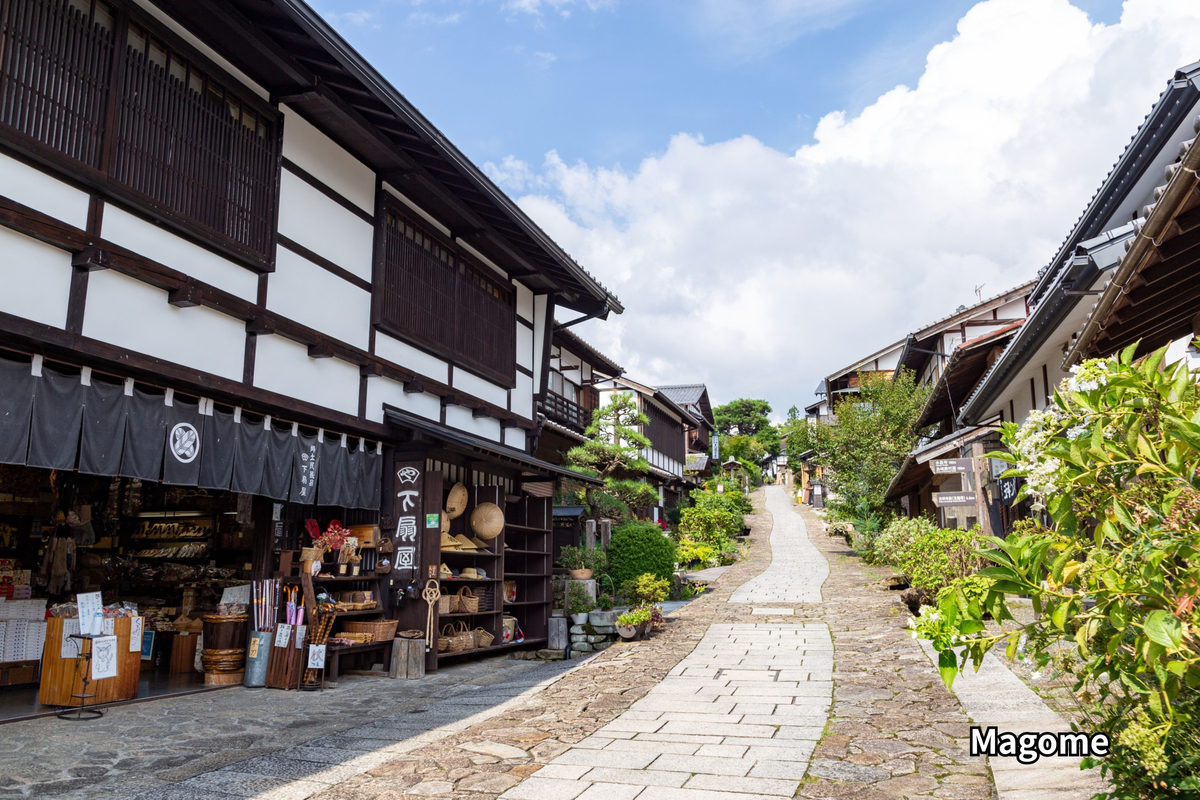
Tsumago is flat, its power lines are buried, and the Edo streetscape is the more faithfully preserved. Magome climbs a stone-paved slope and has the better views. The best answer is to walk the pass and see both.
How hard is the 8 km pass walk?
2.5 km up and 5.5 km down, with about 300 m of climbing from the Magome side. No special fitness needed, and it takes about 3 hours. Going the other way (Tsumago to Magome) means a longer climb, so starting from Magome is easier.
Is there anywhere to eat on the pass trail?
The teahouse at Magome Pass serves free tea but no food. Bring water and snacks with you.
Can vegetarians eat here?
Gohei-mochi (walnut miso), mountain vegetables, and soba all work. Note that soba dipping sauce contains bonito stock, so mention it in advance. Minshuku are usually able to accommodate.
Where do I arrange luggage forwarding?
The tourist offices in Magome and Tsumago run a baggage service between the two towns (around ¥1,000 per bag, March–November). Drop it off in the morning and it reaches the other town the same day.
How many nights should I plan?
For Tsumago and Magome alone, a day trip or one night. Walking from Narai, two to three nights. Our 3-day Nakasendo walking package includes the inns and luggage transfers.
Should I walk from Magome or from Tsumago?
From Magome. You climb from Magome (600 m) to the pass (801 m) and descend to Tsumago (420 m), which is the short way up.
Are the stations far from the towns?
Narai is 5 minutes on foot from its station. Tsumago is 10 minutes by bus from Nagiso; Magome is 25 minutes by bus from Nakatsugawa. Buses are infrequent, so check times before setting out.
Is it safe to walk the pass alone?
In daylight, yes. The trail is clear and well signed. Carry a bear bell and tell your inn your plans. After dark it is genuinely dangerous, because there are no lights.
Can I walk it with my elderly parents?
The 8 km crossing takes about 3 hours and needs no special fitness. But there are stone-paved slopes and unpaved stretches, so for anyone unsteady on their feet, the bus is the better call. Inside the towns the walking is flat and easy.

Plan this trip with IACE
Everything in this article is knowledge we use in real bookings every day. Tell us your dates, group size and interests, and we will turn it directly into your own itinerary.