Shrines and temples at dawn: put jet lag to work, and Fushimi Inari is empty
The same tunnel of torii is a completely different place at 6 AM and at 2 PM. How to spend the early-rising body that only travelers arriving from North America have.
Contents
- Jet lag is a weapon, for exactly the first three days
- Opening times at a glance
- Fushimi Inari at 6 AM and at 2 PM are different places
- Kiyomizu-dera and the luxury of a 6 AM gate
- Mornings in Nara and Tokyo
- Morning or evening: choose by what you want
- The logistics that make a dawn itinerary work
- For the confirmed night owls
- Frequently asked questions
Jet lag is a weapon, for exactly the first three days
Arrive in Japan from Vancouver or Toronto and your body clock is set to feel morning during Japan’s late night and early dawn. After the westbound flight, most people spend two to four days snapping awake around 4 AM. Travelers file this under inconvenience. For anyone who came to see shrines and temples, those few days are conditions you might get once a year.
Japan’s major sights fill up all at once between 9 and 10 AM, when the tour buses, school trips, first sightseeing-loop buses, and hotel-breakfast finishers all start moving together. Which means from 6 to 8 AM they sit nearly deserted. Practically speaking, this is the only way to photograph the Senbon Torii at Fushimi Inari Taisha with nobody in the frame.
Early morning has one more concrete payoff. Kyoto tops 35°C at midday in summer, and any temple with stone steps becomes an ordeal; at 6 AM it is around 25°C. Nara and Kamakura are the same. In high summer, morning is close to the only sane time to walk temple grounds at all. As we wrote in September in Japan, the late-summer heat hangs on into early October.
Opening times at a glance
Sites you can visit at dawn and sites you cannot are divided cleanly by their gate times. Here is the picture as of August 2026. Hours shift by season, so confirm on the official notice the day before.
| Site | Gates open | Admission | Worth going early? |
|---|---|---|---|
| Fushimi Inari Taisha (Kyoto) | 24 hours | Free | Best of all. At 6–7 AM the Senbon Torii stands empty |
| Meiji Jingu (Tokyo) | Sunrise (5:00–6:40, varies by month) | Free | Excellent. The forested approach is the main event |
| Kiyomizu-dera (Kyoto) | 6:00 | About ¥400 | Excellent. The morning view from the stage is yours alone |
| Todai-ji Great Buddha Hall (Nara) | 7:30 (Apr–Oct) | About ¥800 | High. Deer and morning mist on the approach |
| Kasuga Taisha (Nara) | 6:30 (Apr–Sep) | Inner corridor paid | High. The lantern-lined approach is quiet |
| Ise Jingu Naiku (Mie) | 5:00 | Free | Best of all. You can worship from before sunrise |
| Senso-ji (Tokyo) | Grounds 24 hours / main hall 6:00 | Free | High. With Nakamise shuttered, the approach is another world |
| Okunoin, Koyasan (Wakayama) | 24 hours | Free | High. The cedar-lined approach is at its stillest in the morning |
| Kinkaku-ji (Kyoto) | 9:00 | About ¥500 | Low. Crowded from the moment it opens |
| Ginkaku-ji (Kyoto) | 8:30 (Mar–Nov) | About ¥500 | Moderate. Quiet for only the first 30 minutes |
| Sanjusangen-do (Kyoto) | 8:30 | About ¥600 | Moderate. The hall is easiest to view right after opening |
| Tenryu-ji, Arashiyama (Kyoto) | 8:30 | About ¥500 | Moderate. The bamboo grove path is empty around 7 AM |
The most important fact in this table: the dawn play does not work at Kinkaku-ji. It opens at 9, with a line already formed. Get up early and everything is empty is simply not true. Check each gate time and build the morning route around it.
Fushimi Inari at 6 AM and at 2 PM are different places
Kyoto’s most visited site, and the one where early morning pays off most. The grounds have no enclosing wall, so you can enter at any hour, 24 hours a day, and there is no admission fee.
Step off the train at JR Inari Station at 6 AM and the approach is close to deserted. Inside the Senbon Torii you can walk long stretches with no one ahead of you and no one behind. The very same spot at 11 AM is a tunnel too packed to pause in. The full climb to the summit of Mt. Inari (Ichinomine) is a 2–3 hour round trip on stone steps with about 230 m of elevation gain. To the Okusha inner shrine it is about 30 minutes one way, and the main stretch of the Senbon Torii falls within that.
Three practical notes. The approach is lit, but sections of the mountain trail are dark, so entering before sunrise is not the safe choice. The tea houses along the path open around 9, so carry your own drink in the morning. The award office and goshuin start around 8:30, so a dawn visit alone will not get you one. If goshuin matter to you, time the climb up and back so the window is opening just as you come down.
Kiyomizu-dera and the luxury of a 6 AM gate
Among Kyoto’s famous temples, only Kiyomizu-dera opens at 6. It is 6:00 year round, admission about ¥400 (as of August 2026). You stand on the famous wooden stage just as the morning light comes over the Higashiyama hills.
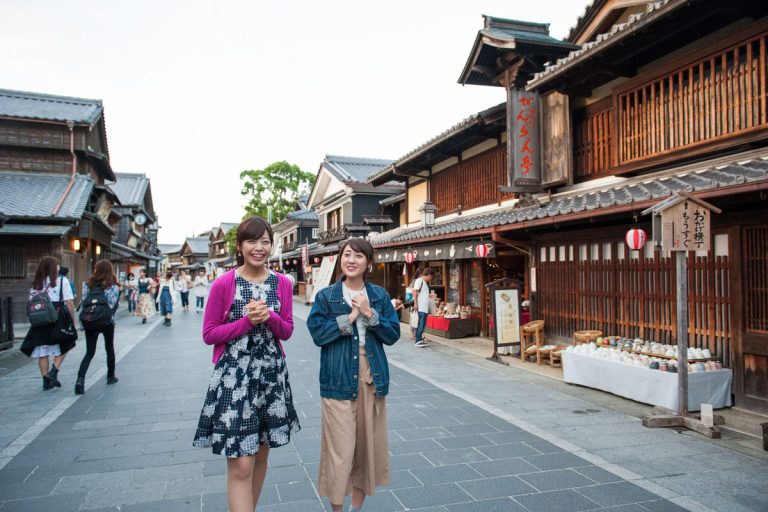
The lanes up to the temple, Sannenzaka and Ninenzaka, overflow with people and souvenir shops by day. Before 7 AM not a single shop is open, and what remains is stone pavement and old townhouses. The morning-and-evening scenery that only overnight guests get to see, which we described in our article on preserved old towns, happens right in the middle of Kyoto.
A suggested route: into Kiyomizu-dera at 6:00, down Sannenzaka at 7:00 to Yasaka Shrine (open around the clock), a walk along the Shirakawa canal in Gion at 7:45, breakfast at 8:30. You will have had the most popular quarter of the city nearly to yourself, with the whole day from 9 AM still untouched.
Mornings in Nara and Tokyo
Todai-ji’s Great Buddha Hall opens at 7:30 (April–October; 8:00 November–March). It stays relatively manageable at any hour, but the morning prize is less the hall than the approach: the deer of Nara Park are livelier early, and the tree-lined walk from the Nandaimon gate to the hall, with mist still hanging, is in a class of its own in photos and in memory. Kasuga Taisha opens at 6:30 (April–September), and its lantern-lined approach is yours alone.
Meiji Jingu runs on a rare system: it opens at sunrise and closes at sunset, so opening time moves between 5:00 and 6:40 depending on the month. A few dozen steps from the noise of Harajuku Station, you enter a broad gravel approach through a forest of 170,000 trees. That contrast is the essence of Meiji Jingu, and only the quiet of morning delivers it. The grounds are large: about 10 minutes on foot from the Harajuku entrance to the main sanctuary.
Senso-ji’s main hall opens at 6:00, and the grounds can be walked through at any hour. The shutters of the Nakamise shopping street are painted with murals you can only see while the shops are closed, which means early morning. And if you want the Kaminarimon gate photographed with no people in it, the 6 AM hour is your only window.
Morning or evening: choose by what you want
Dawn is not the only route to a quiet temple. Late afternoon and night have their own logic. The characters differ, so choose by purpose.
| Time of day | Pros | Cons |
|---|---|---|
| Early morning (6–8 AM) | Empty. Clear air. Cool even in summer. Many sites free | Goshuin, shops, and paid halls are closed. Sparse transit |
| Daytime (9 AM–4 PM) | Everything is open. You can go inside the halls | The most crowded. Hot in summer |
| Late afternoon (4–6 PM) | Soft light. Tour groups gone | Gates close early (often 4:30–5:00 PM) |
| Night illuminations | Special openings in the foliage and cherry seasons. Scenery you get no other way | Limited dates. Often more crowded than daytime. Extra ¥600–1,000 |
A common misconception: illuminations are not quiet. During Kyoto’s autumn light-ups (mid to late November), some temples have longer entry lines at night than during the day. If you want stillness, go at dawn; if you want staged spectacle, go at night. That division matches reality.
The logistics that make a dawn itinerary work
- Stay close to the target. At 6 AM, subways and buses run thin and some lines have not started. For a Kiyomizu morning, stay in Higashiyama; for Fushimi Inari, near Kyoto Station or in Fushimi. Walking distance, or one short taxi, is the ideal.
- Taxis are cheaper and faster at dawn. With no traffic, a stretch that takes 30 minutes at midday takes 15. Base fare about ¥500; a mid-length hop within Kyoto runs ¥1,500–2,500.
- Push breakfast later. Hotel breakfast mostly starts at 7, and waiting for it costs you two hours. Buying at a convenience store the night before is the reliable move.
- Coin lockers may not open before 6. Station lockers generally follow the first trains.
- Save the goshuin for the afternoon. Fold a second, later stop into the route and you get both the empty morning and the stamps.
- Quit after three days. Jet lag fades around day four. Concentrate the dawn raids in the first half of the trip.
For the confirmed night owls
Some people simply cannot rise early, and that is fine. Aim instead for the last hour before the gates close. Most tour buses pull out during the 3 PM hour, and after 4 the grounds, while not morning-quiet, settle down noticeably. Also, unwalled sites can be walked at night: Fushimi Inari, Senso-ji, Yasaka Shrine, Okunoin on Koyasan. Keeping to the lit sections, Yasaka Shrine at 10 PM is an entirely different place from midday. For safety, stay off mountain trails and unlit approaches.
Frequently asked questions
Is early morning really free?
Admission fees apply to enclosed areas such as temple halls and gardens. Fushimi Inari, Meiji Jingu, the Kasuga Taisha approach, the Senso-ji grounds, and the Okunoin approach on Koyasan are free at all times anyway. At places with a ticket window, such as Kiyomizu-dera and Todai-ji, the window opens with the gates.
Are toilets and vending machines available that early?
Toilets on the grounds are usually usable during gate hours, though at 24-hour sites some are locked overnight. Vending machines are everywhere in and around the grounds and run around the clock. Shops and tea houses open around 9.
Is dawn worth it in winter too?
Yes. Kyoto mornings drop to near freezing from December to February, but a shrine or temple under fresh snow is a scene that exists only a few days a year. Note that sunrise comes around 7, so the light arrives about an hour and a half later than in summer. Bring warm layers and shoes with grip.
Can I use a rail pass for the morning trips?
Yes, once the first trains are running. That said, for early-morning moves within a city, walking and taxis are usually the more realistic tools. On whether passes pay off, see is the JR Pass worth it and our regional passes page.
Do you offer tours built around early mornings?
We handle it through custom arrangements. Where you sleep and how you move at dawn are the crux, so contact us once your destinations are set. Sample Kansai itineraries are on our Kyoto and Kansai tours page.

Plan this trip with IACE
Everything in this article is knowledge we use in real bookings every day. Tell us your dates, group size and interests, and we will turn it directly into your own itinerary.