The world heritage sites where you can see Mount Fuji: walking the 25 components from where the mountain is visible
Mount Fuji is a cultural World Heritage site, not a natural one. We sort out which of the 25 components you can actually visit, and how your odds of seeing the mountain change by season and time of day, with numbers.
Contents
- Mount Fuji is not a natural heritage site
- The 25 components, and the trick in the number
- Arakurayama Sengen Park (the Chureito Pagoda) is not a component
- The actual odds of seeing Mount Fuji
- The Fujiyoshida side: three components in half a day
- The Fujinomiya side: the oldest form of Fuji worship
- Miho no Matsubara, and a “different” World Heritage view of Fuji
- Getting there and what it costs
- Frequently asked questions
Mount Fuji is not a natural heritage site
In June 2013, Mount Fuji was inscribed as a UNESCO World Cultural Heritage site. The official name is “Fujisan, sacred place and source of artistic inspiration.” It is not a natural heritage site. If you arrive with that mixed up, half of what there is to see becomes invisible.
In the 1990s, Japan considered a bid for natural heritage status, then abandoned it. The reasons were plain: litter on the trails and around the 5th Station, inadequate sewage treatment, and a toll road with huge parking lots cutting across the mountainside. Against the standard of untouched nature, the Fuji of that era did not qualify.
So the approach changed. What earned the inscription was not the mountain’s beauty but the record of people worshipping, climbing, and painting Mount Fuji for more than 1,200 years: the Sengen faith that deified the mountain, the Fuji-ko brotherhoods of Edo commoners who climbed it in organized groups, and the woodblock prints, above all Katsushika Hokusai’s Thirty-Six Views of Mount Fuji and Utagawa Hiroshige’s work. When those prints reached Europe in the late 19th century, they directly influenced the generation of Van Gogh and Monet. “Sacred place and source of artistic inspiration” is not just the registered name; it is the reason for the listing.
That is why the component sites are shrines, climbing trails, pilgrim lodgings, springs, waterfalls, and a pine grove, not viewing platforms.
The 25 components, and the trick in the number
A caution first. The number 25 does not mean there are 25 attractions. Component No. 1, the “Fujisan Mountain Area,” is one enormous entry containing nine elements: the worship sites at the summit, the four old climbing trails (Omiya-Murayama, Suyama, Subashiri, and Yoshida), Kitaguchi Hongu Fuji Sengen Jinja, and lakes Saiko, Shojiko, and Motosuko. Oshino Hakkai, on the other hand, is eight ponds counted separately, taking up eight entries.
In practice, the number of coherent units to visit is around ten. Here is the full picture.
| Component | Location | Can you visit, and what is there |
|---|---|---|
| Fujisan Mountain Area (summit, 4 climbing trails, Kitaguchi Hongu Fuji Sengen Jinja, lakes Saiko, Shojiko, Motosuko) | Yamanashi / Shizuoka | The summit is accessible only early July to early September. The shrine and the three lakes are open year-round and reachable by public transport |
| Fujisan Hongu Sengen Taisha | Fujinomiya, Shizuoka | Head shrine of the 1,300-plus Sengen shrines nationwide. About 10 min on foot from Fujinomiya Station. Grounds free |
| Yamamiya Sengen Jinja | Fujinomiya | There is no main hall. The object of worship beyond the stone rows is Mount Fuji itself. Best reached by car |
| Murayama Sengen Jinja | Fujinomiya | A base of shugendo mountain asceticism, and the start of the Omiya-Murayama trail. Best reached by car |
| Suyama Sengen Jinja | Susono, Shizuoka | Trailhead of the Suyama route. Giant cedars. Very few visitors |
| Fuji Sengen Jinja (Subashiri) | Oyama Town, Shizuoka | Trailhead of the Subashiri route. An Edo-period gate. Approach from the Gotemba side |
| Kawaguchi Asama Jinja | Fujikawaguchiko, Yamanashi | Seven cedars around 1,200 years old. Bus from Kawaguchiko Station. The worship viewpoint above the approach is a 30-min uphill walk |
| Fuji Omuro Sengen Jinja | Lake Kawaguchi shore | The original shrine, once at the 2nd Station, relocated here. One of the easiest components to reach on the lakeshore |
| Oshi lodging houses (former Togawa and Osano family residences) | Fujiyoshida, Yamanashi | Pilgrim inns where Fuji-ko climbers stayed. Only the former Togawa residence is open (admission around ¥100) |
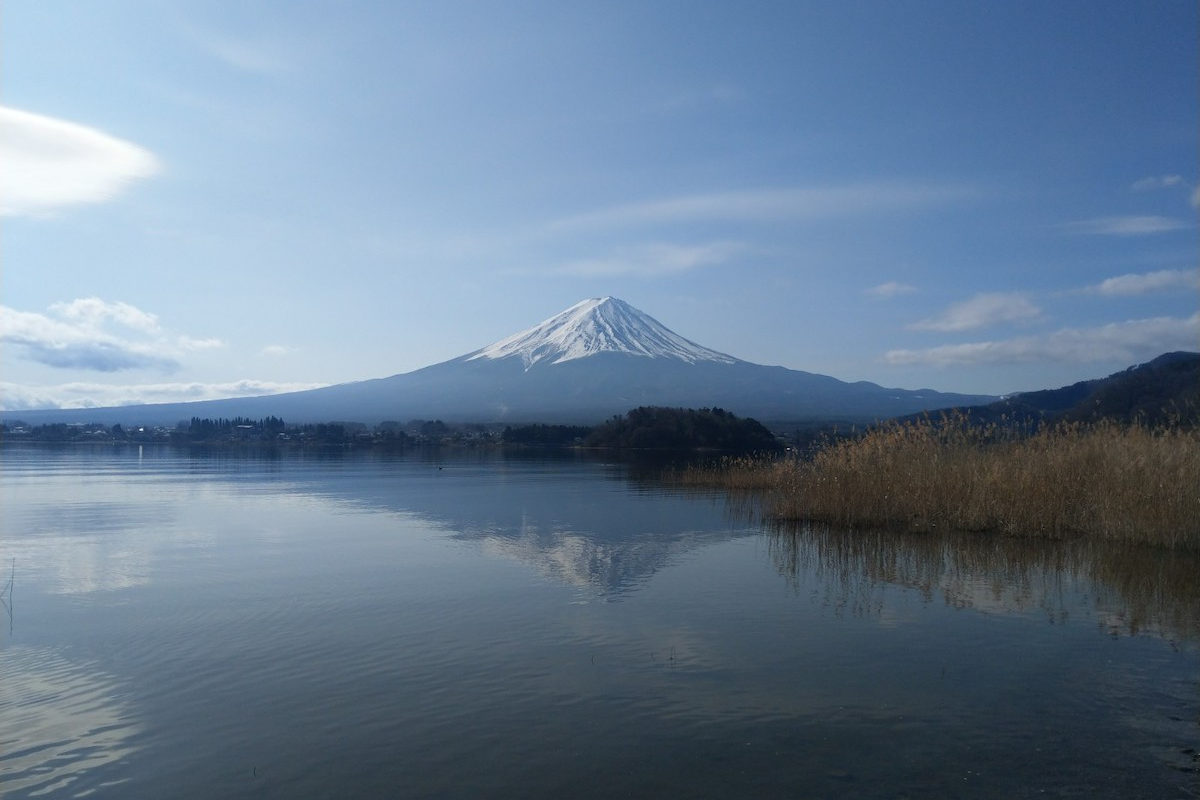
| Lake Yamanaka and Lake Kawaguchi | Yamanashi | The inverted reflection of Fuji on the water was recognized as a “source of artistic inspiration” |
| Oshino Hakkai (8 ponds) | Oshino Village, Yamanashi | Spring ponds fed by Fuji’s underground water. Free. Crowds are the biggest enemy |
| Funatsu and Yoshida lava tree molds | Fujikawaguchiko / Fujiyoshida | Caves formed where lava engulfed trees, revered as the womb of the mountain. Check opening periods |
| Hitoana Fuji-ko Sites | Fujinomiya | The lava cave where the founder of Fuji-ko trained, plus more than 230 stone monuments. Cave interior generally closed |
| Shiraito Falls | Fujinomiya | About 20 m high and 150 m wide. Spring water pours from the whole face of the cliff. Stairs down to the basin |
| Miho no Matsubara | Shimizu Ward, Shizuoka City | A shoreline about 45 km from Fuji. Setting of the celestial-robe legend. Nowhere is the gap between a clear day and a cloudy one larger |
One more fact worth knowing when you look at a map: everything above the 8th Station of Mount Fuji is the sacred precinct of Fujisan Hongu Sengen Taisha. It is not state land. The very fact that what you worship at the summit is a shrine is the substance of this World Heritage site.
Arakurayama Sengen Park (the Chureito Pagoda) is not a component
Search for Mount Fuji in English and the first image you see is almost certainly the one: a five-story pagoda, cherry blossoms, and Fuji in a single frame. That is the Chureito Pagoda in Arakurayama Sengen Park, and it is not a component of the World Heritage site.
The Chureito is a war memorial erected in 1963. It has the shape of a five-story pagoda but is not a temple pagoda, and its history spans barely 60 years. The adjacent Arakura Fuji Sengen Jinja is not a component either. Meanwhile, Kawaguchi Asama Jinja, about 15 minutes away by car, is an official component.
This is not an argument against going. If you are taking exactly one photograph in Japan, there is hardly a better place. It is simply that you will not have “seen a World Heritage pagoda.”
It is about a 10-minute walk from Shimo-Yoshida Station on the Fujikyu line, then 398 steps to the observation deck (a bypass ramp exists). Admission free. The cherry blossoms typically peak in mid April, and in that season you need to arrive before 7 AM to beat the line at the stairs.
The actual odds of seeing Mount Fuji
This is the number that matters most when you plan. Mount Fuji is not a mountain you see just by showing up. Many travelers who arrive at Lake Kawaguchi on a summer afternoon go home without ever seeing it.
Simplify the meteorology and it comes down to this: in winter the air is dry and the mountain shows; in summer, humidity and convection hide it. Mornings are clear; clouds build in the afternoon. Smoothing the year-round observation trends around Lake Kawaguchi into itinerary form gives roughly the following (estimates as of August 2026, not guarantees).
| Season | Visible in the morning (approx.) | Notes |
|---|---|---|
| Dec–Feb | 70–80% | Best odds. But mornings are below freezing and the lakeshore wind is strong |
| Mar and Nov | 50–60% | Reasonably stable. November overlaps with fall colors |
| Apr, May, Oct | 40–50% | Cherry blossom and foliage season. Crowds to match |
| Jun–early Jul (rainy season) | 20–30% | The worst stretch. Avoid it if your dates can move |
| Late Jul–Aug | 20–30% | Climbing season, but the worst season for seeing the mountain from below |
| Sep | 30–40% | Between typhoons come days of astonishing clarity |
Time of day matters even more. The best window is from around sunrise to 9 AM. As the sun climbs, the slopes warm, updrafts form, and by early afternoon cap clouds and cumulus sit on the summit. If you arrive at 3 PM and see nothing, standing in the same spot at 6 the next morning nearly doubles your odds.
The conclusion is simple: if you want to see Mount Fuji, spend a night in Kawaguchiko or Fujinomiya. Most day-trip bus tours from Tokyo reach the lake in the afternoon, the least favorable hours to be there. The day trip is not the problem; the timing is.
For itineraries with an overnight stay, see the Fuji and Hakone tours. For how to structure the trip overall, see the first-trip guide.
The Fujiyoshida side: three components in half a day
Based in Kawaguchiko or Fujiyoshida, you can cover three components in half a day. This town held the trailhead of the Fuji-ko pilgrimages, and the “faith” side of the World Heritage story survives here most strongly.
Kitaguchi Hongu Fuji Sengen Jinja
To state the conclusion first: of all the components, this is the one most worth visiting. About 5 min by bus or 20 min on foot from Fujisan Station, grounds free, open year-round. The approach, lined with cedars around 1,000 years old, is dim even at midday, and the main hall of 1615 stands at the far end.
At the back of the grounds is a small torii. This is the starting point of the Yoshida trail, and the people of Edo passed through this gate and walked to the summit. The trail still exists, and you can walk it up to the 5th Station. Ride the bus straight up to the 5th Station and this structure is invisible.
Oshi lodging house (former Togawa family residence)
The oshi were the people who lodged Fuji-ko pilgrims in their homes, performed prayers, and sent them up the mountain. At its peak, Fujiyoshida had more than 80 oshi houses; a handful survive. The one open to the public is the former Togawa family residence: admission around ¥100, 9:30 AM–5:00 PM (as of August 2026; check closure days before visiting). At the back of the long, narrow lot is the altar room where pilgrims purified themselves before setting out. Allow 20–30 minutes; it is about a 10-minute walk from Fujisan Station.
Oshino Hakkai
Eight ponds where snow that fell on Fuji surfaces after 20-plus years underground. Free entry. But let us be honest: after 10 AM, tour buses make it hard to move. The fix is simple. Go in the 8 AM hour. From Kawaguchiko or Fujisan Station it is 20–25 min by bus, around ¥400.
The Fujinomiya side: the oldest form of Fuji worship
On the south side of the mountain lies Fujinomiya, Shizuoka. It is less known as a tourist stop, but as a heritage of faith it is arguably the main current.
Fujisan Hongu Sengen Taisha
The head shrine of the 1,300-plus Sengen shrines across Japan. About 10 min on foot from JR Fujinomiya Station, grounds free. The two-story main hall, donated by Tokugawa Ieyasu in 1604 in the Sengen-zukuri style, has no parallel elsewhere. The Wakutama Pond in the grounds wells up with Fuji’s underground water, and pilgrims once purified themselves here before the climb.
Yamamiya Sengen Jinja
The place this article most wants to recommend. There is no main hall here. In place of a building, rows of lava stones face straight at Mount Fuji. The form from the era when people worshipped not a building but the mountain itself survives intact. It is the place where the reason for the World Heritage listing can be understood in a single view.
Access, however, is poor. Buses from Fujinomiya Station are infrequent; realistically it is a rental car or a taxi (about 20 min each way). Whether you have a car changes the whole Fujinomiya-side itinerary.
Shiraito Falls
About 20 m high and 150 m wide. Rather than one river falling, spring water drops in threads across the entire face of the cliff. On a clear day, Fuji rises above the falls. About 30 min by bus from Fujinomiya Station, around ¥600. Free entry; parking around ¥500. Allow about 5 minutes of stairs down to the basin and back.
Hitoana Fuji-ko Sites
The lava cave where Hasegawa Kakugyo, regarded as the founder of Fuji-ko, undertook his austerities, plus a field of more than 230 stone monuments raised by believers. The cave interior is closed as a rule due to rockfall. What you can see is the monument field above ground, where stone stelae crowd a cedar wood. It is a strange sight, but there is essentially no public transport. Honestly, without a rental car this is a low-priority component.
Miho no Matsubara, and a “different” World Heritage view of Fuji
Miho no Matsubara
Of the 25 components, this is the farthest from the mountain, about 45 km away. It is the view of Suruga Bay and Fuji through the pines, the stage of the celestial-robe legend, painted countless times by Utagawa Hiroshige and others. During the inscription process, ICOMOS, the advisory body, initially recommended excluding it as too distant. Japan pushed back, and it was ultimately included.
In practical terms, this is a place where you gamble on the weather. On a day when Fuji is invisible, Miho no Matsubara is a pine grove and a beach. It is about 35 min by bus from Shizuoka Station plus a 10-min walk, and the round trip takes half a day. Check the forecast the night before, and if clouds look likely, swap in another plan.
The Nirayama Reverberatory Furnaces (Sites of Japan’s Meiji Industrial Revolution)
There is exactly one place in Japan where you can stand inside a different World Heritage site and see Mount Fuji clearly: the Nirayama Reverberatory Furnaces in Izunokuni, Shizuoka, inscribed in 2015 as a component of the Sites of Japan’s Meiji Industrial Revolution.
Completed in 1857, these furnaces cast cannon. Reverberatory furnaces that actually operated are rare survivors worldwide; four chimneys about 16 m tall still stand. Past those chimneys, you see Fuji. A structure from the era when Japan was copying Western technology, and a mountain worshipped for 1,200 years, in one frame.
Admission is around ¥500 (as of August 2026). About 7 min by bus from Izu-Nagaoka Station on the Izuhakone Railway. Tokyo to Mishima is about 50 min on a Kodama shinkansen, so the round trip fits in half a day.
Kamakura is not a World Heritage site
A common misunderstanding, so let us state it plainly: Kamakura is not a World Heritage site. It was nominated as “Kamakura, Home of the Samurai,” received a not-to-inscribe recommendation in 2013, and Japan withdrew the nomination in the same year Fuji was inscribed. From Inamuragasaki or Shichirigahama on a clear winter day, you can see Fuji beyond Enoshima. It is a superb view; it is just not a World Heritage one.
Getting there and what it costs
Figures are estimates as of August 2026. Timetables and fares are subject to revision.
| Leg | Means | Time | One-way approx. |
|---|---|---|---|
| Shinjuku → Kawaguchiko | Highway bus | About 1 hr 45 min | ¥2,200 |
| Shinjuku → Otsuki → Kawaguchiko | JR + Fujikyu line | About 2 hr 20 min | ¥4,000 |
| Tokyo → Mishima (for Nirayama) | Kodama shinkansen | About 50 min | ¥4,600 |
| Tokyo → Shin-Fuji (for Fujinomiya) | Kodama shinkansen | About 1 hr 10 min | ¥5,500 |
| Tokyo → Shizuoka (for Miho no Matsubara) | Hikari shinkansen | About 1 hr | ¥6,000 |
| Shizuoka Station → Miho no Matsubara | Bus + walk | About 45 min | ¥600 |
Three cautions. First, the Fujikyu line (Otsuki to Kawaguchiko) is not JR, so the Japan Rail Pass is not valid on it. Budget an extra ¥1,200 or so. We run the full pass math in Is the JR Pass still worth it in 2026?.
Second, the Kawaguchiko side (Yamanashi) and the Fujinomiya side (Shizuoka) sit on opposite sides of the mountain. Direct buses run only a few times a day, and going by rail means a long detour. To visit both, use a rental car, or stay two nights and do one side per day.
Third, highway buses from Shinjuku sell out in peak season. Bookings open several weeks ahead; we cover the details in How to use highway buses.
If you want to add historic townscapes to the walk, see our list of Important Preservation Districts; for September weather, see Japan in September. And even if your plans are still loose, feel free to get in touch.
Frequently asked questions
If I do not climb, have I not really seen the World Heritage site?
No. Of the 25 components, the worship sites at the summit are only one element. The shrines, the oshi lodging house, the lakes, the falls, and the pine grove are all at the foot of the mountain and can be visited year-round. Climbing is possible only from early July to early September, a window of about two months, and that happens to be the season when the mountain is hardest to see from below.
Can I visit the components in winter?
The shrines, the lakes, Oshino Hakkai, Shiraito Falls, and Miho no Matsubara are all open year-round. What closes are the Fuji Subaru Line (the road to the 5th Station) and the climbing trails, which shut for winter. In fact, December to February gives the best odds of seeing the mountain: roughly 70–80% on a morning visit. Just come prepared for the cold.
I heard Oshino Hakkai is a letdown.
It depends entirely on the hour. From 10 AM the tour buses converge and the ponds disappear behind people. In the 8 AM hour it is quiet, and Fuji sometimes reflects on the water. Forty minutes is enough for the visit; it is not a place to give a whole day.
Should I stay in Kawaguchiko or Fujinomiya?
For a first visit we recommend Kawaguchiko. Lodging options are plentiful, the highway bus from Tokyo runs direct, and Oshino Hakkai, Kitaguchi Hongu Fuji Sengen Jinja, and Arakurayama Sengen Park are all within day-trip range. If you want to go deep on the history of the faith, or you have a rental car, Fujinomiya packs in more.
Is there a way to check right before whether Fuji is visible?
Live cameras are set up at Kawaguchiko, Lake Yamanaka, Fujinomiya, and elsewhere, so you can check the actual view the night before and the morning of. Even on a day forecast as sunny, the summit is often wrapped in cloud, so the most reliable method is to look at the morning feed and then decide your departure time.
I want the cherry blossoms and Fuji at Arakurayama Sengen Park. When should I go?
Mid April in a typical year. Because of the elevation, the blossoms open a week to ten days later than Tokyo’s. Days when the blossoms are at peak, snow remains on Fuji, and the sky is clear number only about ten a year. On weekends in that window, you need to be in line at the bottom of the stairs before 7 AM.

Plan this trip with IACE
Everything in this article is knowledge we use in real bookings every day. Tell us your dates, group size and interests, and we will turn it directly into your own itinerary.