Temple gardens and karesansui: how to read stone and sand, and the best garden for each season
The rock garden at Ryoan-ji has 15 stones, but from any viewing point you can only see 14. How to read a dry landscape garden, the difference between gardens you sit at and gardens you walk through, and the best of each season, with a table of fees and time needed.
Contents
- A Japanese garden is not a picture. It is something you read
- Reading karesansui, and what the white sand and the stones stand for
- Where is the fifteenth stone in the rock garden at Ryoan-ji?
- Gardens you sit at, and gardens you walk through
- Six representative gardens, with fees, time needed and crowds
- Booking Saiho-ji is, honestly, difficult
- Best by season, from fresh green to autumn colour and snow
- Practical notes for visiting gardens
- Frequently asked questions
A Japanese garden is not a picture. It is something you read
We often watch North American visitors to a Kyoto temple garden look at it for five minutes and move on. It is a waste, though the real problem is that nobody has shown them what to look at.
Most European gardens are built from flowers, geometry and fountains, and the beauty is laid out where you can see it. Japanese temple gardens are different. The placement of stones, the pattern raked into the sand, the relationship to the mountain behind, what is revealed and what is hidden: these are all deliberately designed signs, and there is a way to read them. Know it and you can sit for 30 minutes; do not, and you will be bored in five.
This article explains the basics of reading a dry landscape garden, then puts six well-known gardens into a table with fees, time needed and crowd levels. It ends with an honest account of how hard it is for a foreign traveller to book Saiho-ji, the moss temple.
Reading karesansui, and what the white sand and the stones stand for
Karesansui (dry landscape garden) depicts a water landscape without using a drop of water. It developed in the Muromachi period as the front garden of the hojo, the abbot’s quarters, in Zen temples.
The basic correspondences are simple.
- White sand (in practice, crushed granite known as shirakawa-suna) stands for water: the sea, a river, or simply empty space
- The raked pattern is the movement of water: straight lines are a calm surface, spirals are waves, and concentric rings around a stone are waves breaking on an island
- Upright stones are mountains, or a waterfall. A stone grouping representing a waterfall is called a karetaki, stacked so that water appears to fall where there is none
- Recumbent stones are islands, boats or animals. A crane island paired with a turtle island is the standard motif for long life
- Moss usually represents the ground of an island or a stretch of land
Left alone the raked pattern breaks down, so at most temples the monks redraw it every few days. Go early and you may see a freshly raked, unbroken pattern. By afternoon, wind and fallen leaves have disturbed it a little. Which you prefer is up to you, but for photographs, mornings.
Where is the fifteenth stone in the rock garden at Ryoan-ji?
The hojo garden at Ryoan-ji is a rectangle roughly 25 m by 10 m holding nothing but white sand and 15 stones. There is almost no planting, and an oil-and-clay wall encloses it. Neither the date nor the designer has been established.
What the garden is best known for is that from anywhere on the veranda, only 14 of the 15 stones are visible. The stones are set in five groups of five, two, three, two and three, arranged so that one is always hidden behind another. This is often explained as an expression of the idea that nothing is ever complete, though the temple has never officially declared that meaning. Move along the veranda from left to right, counting as you go, and you can watch which stone drops out of sight.
One warning. This place gets extremely crowded. If you cannot sit on the veranda, you will experience almost none of what the garden was designed to do. Opening is 8:00 from March to November and 8:30 from December to February. Reach the veranda by 8:15 and you will get a seat. After 9:30 it becomes a standing queue with an unspoken pressure to move on within ten minutes. It is one of the very few places where getting up early purely to see a garden is worth it.
Gardens you sit at, and gardens you walk through
Japanese gardens divide broadly into two kinds. Go without knowing the difference and you will get your time allocation backwards.
Gardens you sit at (hojo gardens, karesansui) are designed to be seen from one fixed position, the veranda of a building. Because the viewpoint is fixed, the composition is finished. They are not for walking around; the correct use is to sit for 15 to 30 minutes. Ryoan-ji, the sub-temples of Daitoku-ji and the Tofuku-ji hojo are all of this type.
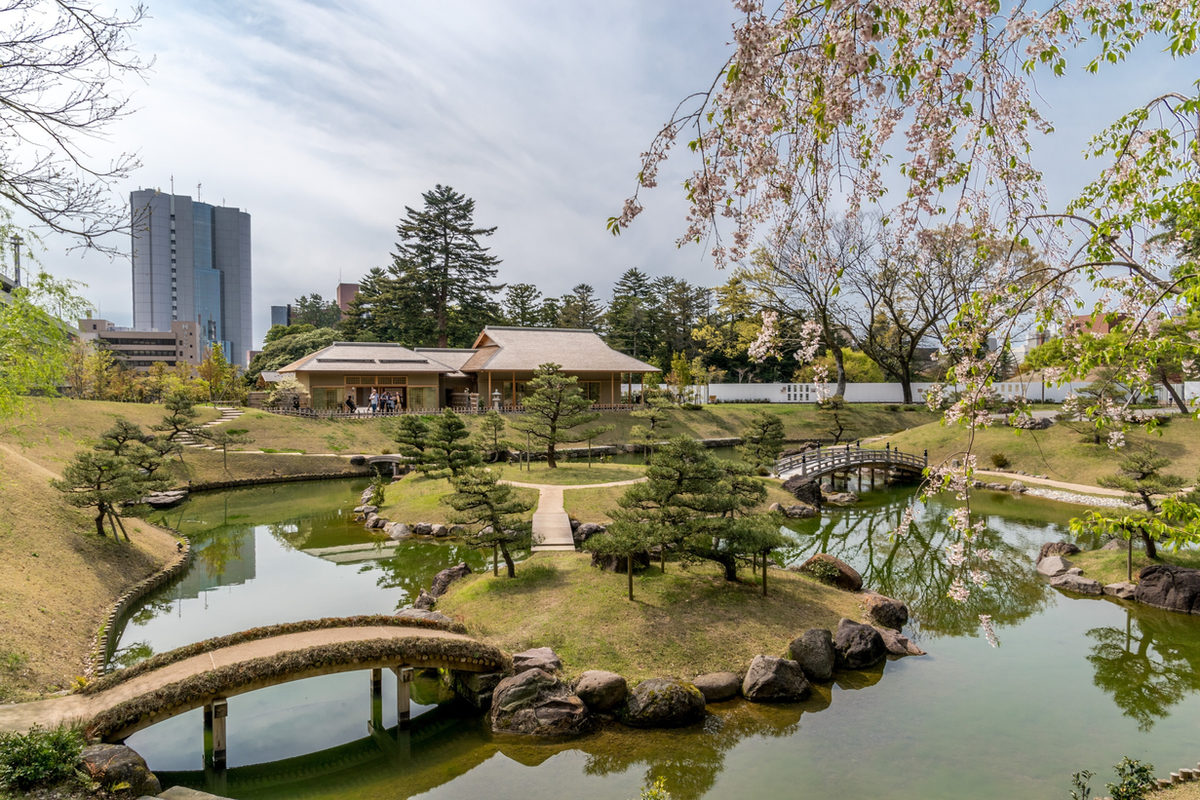
Gardens you walk through (chisen kaiyu, pond-and-stroll gardens) are experienced by walking the path around a pond as the scenery changes. They assume a moving viewpoint, and are designed so that a new composition appears at each turn. Ginkaku-ji, Tenryu-ji, Sanzen-in and the great daimyo gardens like Kenroku-en in Kanazawa belong here. Allow 30 to 60 minutes.
The common mistake is to allot 30 minutes to a sitting garden and rush a walking garden in 10. Simply checking which kind you are visiting in advance changes the experience.
Six representative gardens, with fees, time needed and crowds
Fees and times are approximate as of August 2026, and change during special openings and the autumn colour season. Crowd levels are based on weekday daytime visits.
| Garden | Type | Typical admission | Opens | Time needed | Crowds | Highlights |
|---|---|---|---|---|---|---|
| Ryoan-ji hojo garden | Sitting (karesansui) | ¥600 | 8:00 (8:30 in winter) | 30–45 min | High | The 15 stones. Whether you get a seat on the veranda by 8:15 decides the whole experience |
| Ginkaku-ji (Jisho-ji) | Walking, plus karesansui | ¥500 | 8:30 (9:00 in winter) | 45 min | High | The sand forms known as Ginshadan and Kogetsudai. The path up the hill behind gives you Kyoto over the rooftops |
| Tenryu-ji, Sogenchi garden | Walking | ¥500 for the garden, +¥300 for the halls | 8:30 | 45 min | Medium to high | By Muso Soseki. Arashiyama and Mount Kameyama are pulled in as shakkei (borrowed scenery). The pond is said to be unchanged in shape since the temple was founded in 1339 |
| Tofuku-ji, Tsutenkyo bridge | Walking, plus hojo garden | ¥600 (¥1,000 in autumn) | 9:00 (8:30 in autumn) | 60 min | Medium (extreme in autumn) | Around 2,000 maples in the ravine below the Tsutenkyo bridge. The hojo garden, laid out by Mirei Shigemori in 1939, is modern karesansui |
| Saiho-ji (Koke-dera) | Walking (moss) | ¥4,000 and up | Advance application required | 90 min | Low (numbers capped) | A pond garden under roughly 120 species of moss. You take part in sutra copying or similar before viewing the garden |
| Sanzen-in (Ohara) | Walking (moss and cedar) | ¥700 | 9:00 | 60 min | Low to medium | Moss and cedar groves in the Yusei-en garden, and the Ojo Gokuraku-in hall. Small Jizo figures tucked into the moss. About 60 minutes by bus from Kyoto Station, and quiet for it |
Booking Saiho-ji is, honestly, difficult
Saiho-ji is famous for a garden covered in roughly 120 species of moss, and as a garden it is among the finest in Kyoto. It is also one of the hardest temples in the country for an overseas visitor to get into. Here is the honest explanation.
For a long time Saiho-ji ran an advance application system by reply-paid postcard. You bought a return postcard inside Japan, wrote your preferred date, party size and the name of the lead applicant, mailed it, and received permission on the reply half. For someone living in North America this was effectively impossible. The only routes were asking an acquaintance in Japan or going through a travel agency.
In recent years online applications through the official website have been introduced and things have improved. Even so, the application method, the fee and the booking window are all subject to change. A visit includes taking part in a religious activity such as copying a sutra, runs about 90 minutes, and the offering starts at ¥4,000. If you plan to go, check the official site for current information at least two months before you travel.
And here is the other honest point. If moss is the whole objective, Sanzen-in is a perfectly good substitute. The Yusei-en garden at Sanzen-in is a carpet of moss under cedar; admission ¥700, no reservation, open from 9:00. It is an hour by bus out to Ohara, but that hour is far less trouble than a reply-paid postcard. We think Saiho-ji is for people who have a specific reason it has to be Saiho-ji.
Best by season, from fresh green to autumn colour and snow
The same garden becomes a different garden with the season. If your travel dates are already fixed, choose the gardens that suit them.
Fresh green (mid-May to mid-June)
The most underrated season of the year. New maple leaves have exactly the shape they will have in autumn, but in yellow-green. They transmit light, so they photograph brighter than autumn colour does. And the crowds are less than a fifth of the autumn peak. See the Tsutenkyo bridge at Tofuku-ji in fresh green and it feels like a different place from the one you would see in November. It is also the best time for moss: once the rainy season starts, the moss at Sanzen-in and Saiho-ji is at its deepest.
Autumn colour (mid-November to early December)
Kyoto’s autumn peak runs from about November 20 to around December 5. Tofuku-ji, Tenryu-ji and Eikan-do draw visitors from all over Japan, domestic travellers included. For those two weeks Kyoto becomes one of the most crowded destinations in the country. If you go, be there at opening, and expect higher admission fees. If you cannot tolerate crowds, we do not recommend Kyoto gardens in this period. Escaping to Ohara, Takao or somewhere else outside the city centre is the more realistic option.
Snow (January to February)
Snow settles in central Kyoto only a few times a year. When it does, Kinkaku-ji, Ginkaku-ji and Ryoan-ji are at their most beautiful of the whole year, but you cannot plan for it. In probability terms, a week in Kyoto gives you roughly a 30 per cent chance of catching snow on the ground. If you definitely want a garden under snow, Kenroku-en in Kanazawa (with its yukitsuri rope supports up from November to March) or gardens in Tohoku are far more predictable. If you are adding Kanazawa, see our Chubu and Hokuriku tours.
Summer (July to August)
Kyoto summers are hot and humid, and walking outdoor gardens in the middle of the day becomes punishing. Early morning is the exception: the air between 6:00 and 8:00 is startlingly cool, and there is nobody about. If you are considering late August into September, our article on September in Japan is worth a look.
Practical notes for visiting gardens
- You will often need to take your shoes off. Any garden viewed from a hojo or shoin requires it. Wear shoes that come on and off easily, and socks without holes
- Verandas are bare boards and get cold in winter. In January and February, thick socks are the difference between 5 minutes and 30
- Tripods are banned at most temples. Set your camera up to shoot handheld
- Never step onto the sand. Redrawing the raked pattern takes hours
- At most temples the ticket window closes 30 minutes before the gate does. If closing is 16:30, treat 16:00 as the real deadline
For building a Kyoto trip around gardens, see our Kyoto and Kansai tours; for a specific itinerary, get in touch through our contact page.
Frequently asked questions
How much time should I allow for a garden?
About 30 minutes for a sitting garden such as a karesansui, and 45 to 60 minutes for a garden you walk around a pond. Put four or more gardens into one day and none of them will leave much of an impression. Two per half day, three at most, is the right amount in our view.
Do I really have to go to Ryoan-ji early in the morning?
Yes, because whether you get a seat on the veranda changes the experience completely. Opening is 8:00 from March to November. Arrive by 8:15 and you will almost certainly sit. If that is impossible, the last hour before closing is also relatively free. Between 10:00 and 15:00 you will be standing and looking over other people.
Can I enjoy a karesansui without understanding its meaning?
Yes. That said, remembering three correspondences will let you see more: white sand is water, upright stone is mountain or waterfall, and recumbent stone is island. You do not have to accept any particular religious interpretation. Seeing it as a designed landscape is enough.
Can I apply to Saiho-ji if I do not live in Japan?
Online applications have been introduced in recent years, so it is more realistic than it used to be. Because the method and conditions can change, check the official site for current information at least two months before you travel. If you would rather not deal with it and moss is the objective, Sanzen-in is a good substitute.
Should I avoid Kyoto gardens during the autumn colours?
Between about November 20 and December 5, Tofuku-ji and Eikan-do have queues before opening and one-way routes inside. The colour itself is superb, but appreciating the place as a garden is hard under those conditions. If crowds bother you, pick somewhere outside the city centre such as Ohara or Takao in the same period, or move your plans to the fresh green of May.
Can I take photographs in the gardens?
The gardens themselves can be photographed at almost every temple. Tripods and selfie sticks are banned at many, though, and Buddhist statues inside halls are generally off limits. Follow the signs at the entrance. It is also better not to cut in front of someone sitting on the veranda looking at the garden in order to get your shot.

Plan this trip with IACE
Everything in this article is knowledge we use in real bookings every day. Tell us your dates, group size and interests, and we will turn it directly into your own itinerary.