What to know before visiting Ise-Shima: local etiquette and pitfalls
The things that catch North American travelers off guard in Ise-Shima, laid out in advance. Less about danger, more about not losing time and money.
Contents
Ise-Shima poses no safety concerns. What matters is that Ise Jingu is an active religious site of the highest rank, with expectations about how you conduct yourself, and that this is a coastal region where typhoons and tsunami are part of the picture.
Things that catch visitors off guard
| Topic | How it really works |
|---|---|
| Worship etiquette | Bow at the torii, do not walk down the centre of the approach (the seichu), and bow twice, clap twice, bow once |
| No photography at the main sanctuary | At both the Naiku and the Geku, photography is prohibited above the stone steps |
| Gravel approaches | Long stretches of coarse gravel. Comfortable shoes are necessary |
| New Year crowds | January 1–5 brings hundreds of thousands. The wait to worship can run to hours |
| Typhoons | August to October sits in the typhoon track. Rail services sometimes suspend in advance |
| Tsunami evacuation | The Shima coast is signed with tsunami evacuation routes |
| Okage Yokocho closes early | Around 17:00. Evenings here are quiet |
How to handle yourself
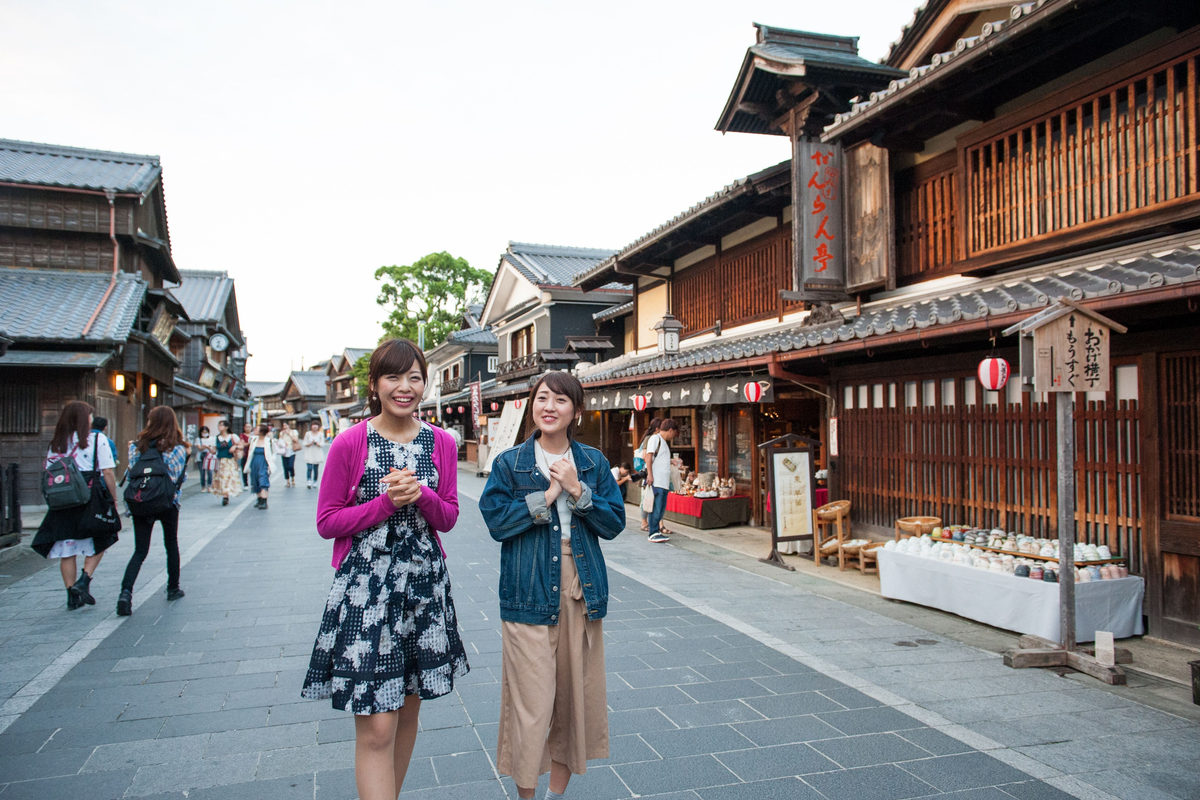
Ise Jingu is among the most formally revered places in Japanese Shinto. Bow before passing through a torii, and walk to the side of the approach, since the centre is considered the path of the deity. By custom you keep right at the Naiku and left at the Geku. Purify your hands at the Isuzu River washing place before approaching the main sanctuary. Photography above the stone steps at the sanctuary is prohibited; we would suggest taking in the atmosphere rather than reaching for a camera. Okage Yokocho is a commercial district recreating an Edo-period street, and photography there is unrestricted.
If something goes wrong
Police 110, fire and ambulance 119. There are hospitals in Ise and Toba. August to October is typhoon-prone, and both Kintetsu and JR sometimes suspend services in advance. If you are staying on the Shima coast, check the tsunami evacuation route. The region lies in the projected zone of a Nankai Trough earthquake, so disaster awareness runs high locally. Installing the Safety Tips app gets you emergency alerts in English.
Frequently asked questions
Is there a dress code?
There is no formal rule, but this is the highest-ranking shrine complex in Japan. Avoid very revealing clothing, and removing your hat when you worship is considered proper.
Can I buy amulets and talismans?
Both the Naiku and the Geku have offices for them. The jingu taima talisman from Ise Jingu is the most widely enshrined of any in Japanese homes, which makes it a meaningful thing to take back.
Let us handle the arrangements
If you book through us, you can reach your contact at our Toronto or Vancouver office whenever trouble comes up on the ground, and we take over any negotiation with hotels and transport providers in Japanese.
See Ise Jingu bus tours Free consultation
Planning essentials for Ise-Shima
Beyond the main topic of this article, here is a summary of everything you need to plan a trip to Ise-Shima, with links to the full article on each subject.
A one-day route at a glance
9:00 Ise-shi station and the Geku (Toyouke Daijingu) → 10:30 Bus to the Naiku → 11:00 The Naiku (Kotai Jingu) → 12:30 Okage Yokocho and Oharaimachi → 14:30 Futami Okitama Shrine and the Meoto Iwa → 16:00 Toba and Mikimoto Pearl Island → 17:30 On to Shima and Kashikojima
With half a day: the Geku, the Naiku, and Okage Yokocho. The shrine visits alone take 3–4 hours.
Extending beyond day one
Day 2 is the Shima coastline: the ria views from the Yokoyama observatory, a cruise on Ago Bay, and a meal at an ama hut. Or a circuit of the auxiliary shrines of Ise Jingu, a name that covers 125 shrines in total. On day 3, enter the Iseji route of the Kumano Kodo, or return to Nagoya or Osaka. Ise is also the starting point of the Iseji: the 170 km road toward the Kumano Sanzan begins here. For the full timed itinerary, see the Ise-Shima itinerary.
Seasons and temperatures
| Season | Typical temperatures | Highlights and cautions |
|---|---|---|
| Spring (Mar–May) | 9–23C | Cherry blossoms early April. May is the most comfortable, with fresh green along the shrine approaches |
| Summer (Jun–Aug) | 22–31C | Humid, with typhoon exposure. July and August are the swimming season on the Shima coast |
| Autumn (Sep–Nov) | 12–26C | September brings typhoons. October and November are the best months. Foliage late November |
| Winter (Dec–Feb) | 4–12C | Mild, with rare snow. The New Year visits of January 1–5 draw crowds in the hundreds of thousands |
October–November and April–May are the two most comfortable windows. Avoid January 1–5 (hundreds of thousands of New Year worshippers) and August (humidity and typhoons). An early-morning visit is the finest hour of the day in any season, and the Naiku admits worshippers from sunrise. Clothing guidance and seasonal events are covered in the best time to visit Ise-Shima.
What to eat
- Ise-ebi (spiny lobster): The prefectural fish of Mie. As sashimi or grilled in the shell. Season October–April. From ¥5,000 each
- Abalone: Harvested by the ama divers of Shima. Grilled live or as steak. Expensive, but it is the symbol of Ise-Shima
- Ise udon: Very thick, very soft noodles coated in a dark, concentrated sauce. Made easy to digest for pilgrims
- Tekone-zushi: Marinated bonito folded through rice, a fisherman’s dish and the local staple of Shima
- Akafuku: Founded in 1707. Mochi wrapped in sweet bean paste. At the main shop in Okage Yokocho you get it freshly made
- Matsusaka beef: One of the three great wagyu of Japan. Matsusaka is 30 minutes from Ise by train
- Oysters: From Toba and Matoya. In season November–March, with all-you-can-eat grilled oyster huts on the shore
Lunch ¥1,000–2,500 (Ise udon around ¥600). A spiny lobster or abalone kaiseki runs ¥10,000–20,000. Inns in Shima with two meals are ¥18,000–40,000, built around seafood. Grazing at Okage Yokocho comes to around ¥2,000. For where to find each dish, see what to eat in Ise-Shima.
Budget at a glance
A one-night, two-day trip runs ¥35,000–55,000 per person (roughly CA$350–550): one night in Shima with two meals ¥25,000, round trip from Nagoya ¥6,000, street food and lunch ¥4,000, and ¥3,000 for transport and admissions. Visiting Ise Jingu itself costs nothing.
Hotel rates by class and the cuts that actually save money are detailed in the Ise-Shima budget guide.
Getting there
The most convenient way into Ise-Shima is the Kintetsu limited express from Nagoya or Osaka. The JR Mie rapid service also runs, but less frequently. If you hold a nationwide JR Pass, the JR route costs nothing extra.
| Route | Time | Notes |
|---|---|---|
| Nagoya → Ise-shi | approx. 1 hr 20 min | Kintetsu limited express, around ¥3,000 (not covered by the JR Pass) |
| Nagoya → Ise-shi (JR) | approx. 1 hr 30 min | JR Mie rapid service, ¥2,020. Covered by the JR Pass. One or two an hour |
| Osaka Namba → Ise-shi | approx. 1 hr 45 min | Kintetsu limited express, around ¥3,500 |
| Kyoto → Ise-shi | approx. 2 hr | Kintetsu limited express, around ¥3,900 |
| Ise-shi station → the Geku | approx. 5 min | On foot. The visit begins at the Geku |
Local transport and the passes worth buying are covered in getting to Ise-Shima.
More frequently asked questions about Ise-Shima
Should I visit both the Geku and the Naiku?
The old form is to visit the Geku first. Visiting only the Naiku is called katamairi, a one-sided visit, and has traditionally been avoided. The two together take 3–4 hours.
What makes Ise Jingu special?
It is held to be 2,000 years old, and for 1,300 years the halls have been rebuilt every 20 years in the shikinen sengu. The buildings are always new, yet the form stays ancient. It is the origin point of Japanese religious architecture, and the Naiku enshrines the ancestral deity of the imperial family.
What time of day should I visit?
Early morning. The Naiku admits worshippers from sunrise (5:00–6:00 depending on the season). There are few people, and the air along the Isuzu River and the approach is at its clearest.
What about visiting at New Year?
Hatsumode is worth experiencing as a piece of Japanese culture, but January 1–5 brings crowds in the hundreds of thousands, and the wait to reach the sanctuary can run to hours. To avoid the crush, come from mid January onward.
Is Ise udon good?
Opinions divide. The noodles are very thick, very soft, and have no bite at all. That is deliberate: they were made digestible for pilgrims arriving from long journeys. Eat it knowing the history and the texture makes sense.
What is the ama hut experience?
Working and former ama divers grill seafood over a hearth and you eat it in the hut (reservation required, ¥4,000–8,000). Ama culture survives only in Ise-Shima and on Jeju Island in Korea.
Is a Shima resort worth it?
Yes. The setting over the ria coast of Ago Bay, and kaiseki dinners of spiny lobster and abalone. But the price matches. If the shrine visit is your main purpose, a hotel in Ise city is entirely sufficient.
Can I do it as a day trip from Nagoya?
Yes. It is an hour and a half each way, so you can leave in the morning, cover the Geku, the Naiku, and Okage Yokocho, and return in the evening. Adding Shima requires an overnight.
Is Kintetsu or JR better?
With a JR Pass, JR: the Mie rapid service costs nothing extra. Without one, the Kintetsu limited express is more frequent and more comfortable. The difference in journey time is about 10 minutes.
How do I get between the Geku and the Naiku?
A 15-minute bus for ¥470, three or four an hour. Walking takes about 50 minutes, but it follows the tree-lined Miyuki Road and is worth doing if you have the time.

Plan this trip with IACE
Everything in this article is knowledge we use in real bookings every day. Tell us your dates, group size and interests, and we will turn it directly into your own itinerary.