What to know before visiting Nara: local etiquette and pitfalls
The things that catch North American travelers off guard in Nara, laid out in advance. Less about danger, more about not losing time and money.
Contents
Nara has no safety concerns to speak of. The single biggest caution is the deer, and that is not a joke. Twelve hundred wild deer walk the park, and every year visitors are bitten and butted.
Things that catch visitors off guard
| Topic | How it really works |
|---|---|
| The deer are wild animals | More than 100 incidents are reported a year. They bite, butt, and kick |
| How to hold deer crackers | Holding them up and teasing brings the herd. Give them straight away, or do not carry them |
| Watch your paper | They will bite at maps, leaflets, and paper bags. Keep them inside your bag |
| Fawn season | May to July is calving season, and mothers become extremely nervous. Do not approach |
| Stags before the antler cutting | September and October is the rut, when males turn aggressive. The antler-cutting ceremony is in October |
| Nara Park is big | Todaiji to Kasuga Taisha is 20 minutes on foot. Budget for the walking |
| Few restaurants at night | After 8 PM the choices drop away sharply |
How to handle yourself
The deer of Nara Park are wild animals designated a national natural monument. They are not pets. Do not chase them, hug them, or force contact. Feeding anything other than the official deer crackers is prohibited, bread and sweets and plastic included; deer have died from swallowing plastic. Todaiji, Kofukuji, and Kasuga Taisha are working religious institutions, so follow the no-photography signs inside the halls. Naramachi is a residential quarter.
If something goes wrong
Police 110, fire and ambulance 119. Nara city has hospitals. If a deer bites you, have the wound disinfected even if it looks shallow. Nara Park posts multilingual warnings about deer incidents. Take summer heatstroke seriously too: the park has plenty of shade, but basin heat here is no different from Kyoto. Clients booked with us can reach their consultant in Japanese.
Frequently asked questions
Are the deer really dangerous?
More than 100 contact incidents are reported a year. Most involve deer crackers, and serious injuries are rare, but being bitten or butted genuinely happens. If you do not tease them with a cracker in your hand, nothing much goes wrong.
Can I make a deer bow to me?
Some deer lower their heads when shown a cracker. That is not a bow. It is closer to the posture that precedes butting with the antlers. Do not tease. Hand it over straight away.
Let us handle the arrangements
If you book through us, you can reach your contact at our Toronto or Vancouver office whenever trouble comes up on the ground, and we take over any negotiation with hotels and transport providers in Japanese.
See Nara World Heritage tours Free consultation
Planning essentials for Nara
Beyond the main topic of this article, here is a summary of everything you need to plan a trip to Nara, with links to the full article on each subject.
A one-day route at a glance
9:00 Kintetsu Nara station → 9:15 Kofukuji → 10:30 Nara Park and the deer → 11:15 Todaiji and the Great Buddha Hall → 12:30 Nigatsudo and Sangatsudo → 13:30 Lunch → 15:00 Kasuga Taisha → 16:30 Naramachi
With half a day: Kofukuji, Nara Park, Todaiji. Those three are within walking distance and are the heart of Nara.
Extending beyond day one
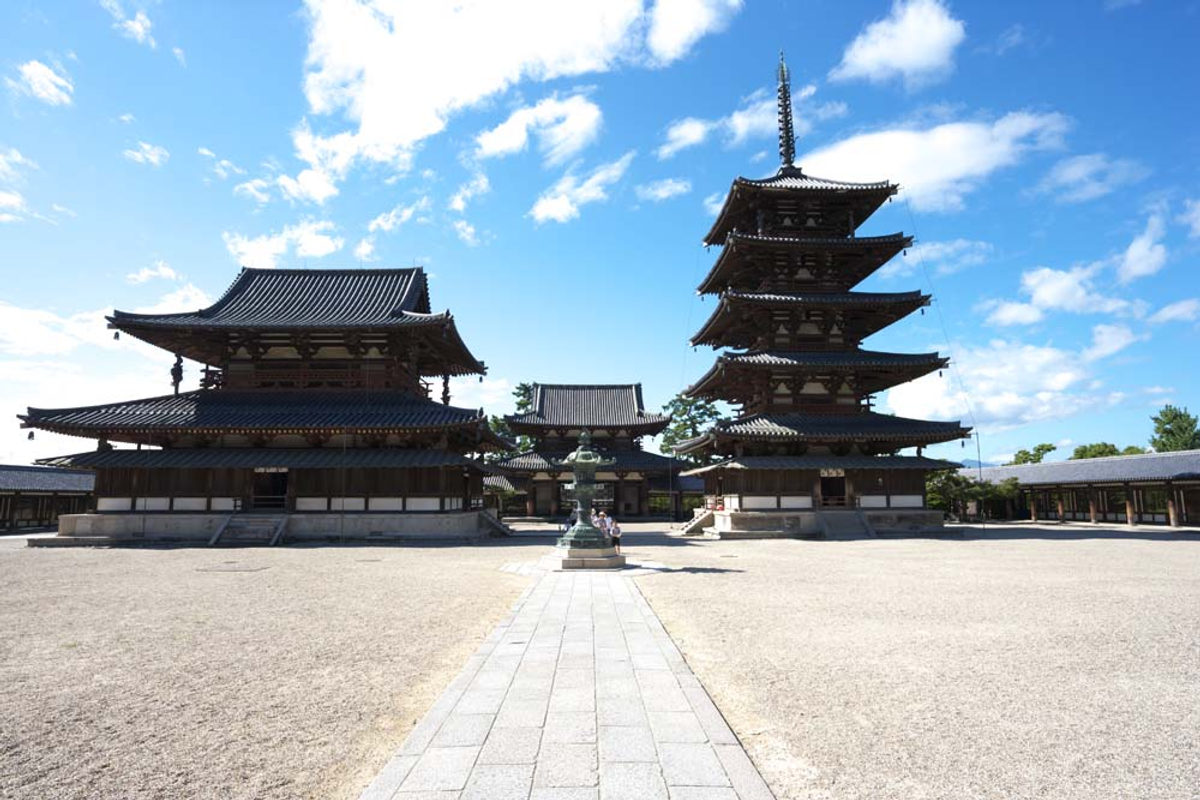
Day 2 is Horyuji (50 minutes by bus from Nara station), the oldest group of wooden buildings in the world and Japan’s first World Cultural Heritage site. Another option is Asuka, where Japan begins, with the Ishibutai and Takamatsuzuka tombs; or Yoshino, a cherry blossom site with 30,000 trees covering an entire mountain. Day 3: cycle around Asuka village, or return to Osaka or Kyoto. Nara is an easy day trip from Kyoto or Osaka, but the park after dark and Todaiji at eight in the morning belong to those who stay the night. For the full timed itinerary, see the Nara itinerary.
Seasons and temperatures
| Season | Typical temperatures | Highlights and cautions |
|---|---|---|
| Spring (Mar–May) | 8–25C | Blossoms late March to early April. Mt. Yoshino peaks in mid April, with the whole mountain turned to blossom |
| Summer (Jun–Aug) | 23–34C | Humid heat. The shade of Nara Park and the temple halls are where you retreat |
| Autumn (Sep–Nov) | 11–27C | Foliage mid to late November, and less crowded than Kyoto |
| Winter (Dec–Feb) | 1–10C | Cold from the ground up. The Wakakusayama grass burning in January and Omizutori in March are the main events |
October–November and late March to May. Even in late November, when Kyoto foliage crowds peak, Nara stays relatively calm. The Mt. Yoshino blossoms in mid April are on a different scale from any other cherry site in Japan. Clothing guidance and seasonal events are covered in the best time to visit Nara.
What to eat
- Kakinoha-zushi: Mackerel or salmon on vinegared rice, wrapped in a persimmon leaf. Pressed sushi, and a preserve born of a landlocked place
- Chagayu: The Nara household breakfast: rice simmered thin in roasted hojicha tea
- Miwa somen: Originating in Miwa, Sakurai. It is held to be the origin of somen noodles in Japan
- Narazuke: Melon pickled in sake lees. A pickle that dates from the Nara period itself
- Yamato chicken and Yamato beef: Nara’s own poultry and wagyu. Little known, but of high quality
- Kamameshi: A standard at Nara restaurants: seasoned rice cooked in an individual clay pot
- Warabimochi and kuzumochi: Sweets made with Yoshino kudzu starch. Translucent and remarkably smooth
Lunch ¥1,200–2,500, dinner ¥3,000–6,000. Nara runs 20–30 percent below Kyoto, with few tourist-priced places. Kakinoha-zushi is around ¥200 a piece and travels well as a portable lunch. For where to find each dish, see what to eat in Nara.
Budget at a glance
A day trip from Kyoto or Osaka runs ¥8,000–13,000 per person (roughly CA$80–130): return fare ¥1,400, admissions ¥2,500, food ¥4,000, souvenirs ¥2,000. Adding Horyuji puts about ¥3,000 on top.
Hotel rates by class and the cuts that actually save money are detailed in the Nara budget guide.
Getting there
Nara is 45 minutes from both Kyoto and Osaka. There are two routes, JR and Kintetsu, and Kintetsu Nara station is closer to Nara Park (five minutes on foot). From JR Nara station it is a 20-minute walk or a bus.
| Route | Time | Notes |
|---|---|---|
| Kyoto → Nara | approx. 45 min | JR Nara line Miyakoji Rapid, ¥720. The Kintetsu limited express takes 35 minutes for ¥1,280 |
| Osaka (Namba) → Kintetsu Nara | approx. 40 min | Kintetsu Nara line, ¥680. By JR, the Yamatoji Rapid at ¥820 |
| Kansai Airport → Nara | approx. 90 min | JR or Kintetsu, changing at Tennoji or Tsuruhashi |
| Kintetsu Nara station → Todaiji | approx. 15 min | On foot, straight through Nara Park |
| Nara → Horyuji | approx. 50 min | JR Yamatoji line plus bus, or a direct bus, ¥770 |
Local transport and the passes worth buying are covered in getting to Nara.
More frequently asked questions about Nara
Can Nara be done as a day trip?
Yes. It is 45 minutes from Kyoto or Osaka, and the main sights are all within walking distance of each other. But Nara Park after sunset and Todaiji at 8 AM require staying the night.
Which is older, Kyoto or Nara?
Nara. The Nara period ran 710–794, after which the capital moved to Kyoto (Heiankyo). The Buddhist sculpture and architecture of Nara belong to the oldest layer of Japanese Buddhist art.
Can I see Omizutori?
It is the rite at Nigatsudo of Todaiji from March 1 to 14, and the Otaimatsu torches at night are open to anyone. The 12th is the largest night and is extremely crowded. It has run unbroken for more than 1,270 years, which puts it among the oldest annual observances in Japan.
When are the Yoshino blossoms?
Mid April. They open from the foot of the mountain upward over roughly a month. Thirty thousand trees covering a mountain puts it on a different scale from other cherry sites in Japan.
What do I do in Nara at night?
The number of restaurants is limited and many close after 8 PM. Naramachi has a handful of izakaya and restaurants, and we would recommend booking. Returning to Osaka or Kyoto for dinner is also a realistic choice.
Is there vegetarian food?
Nara is a Buddhist city, and there are temples and restaurants serving shojin ryori. More Naramachi cafes are offering vegetarian options too. Tell us in advance and we will arrange it.
Is staying in Nara worth it?
Nara Park after the day visitors leave, and Todaiji at 8 AM, belong to overnight guests alone. The deer, the lanterns, the quiet approach. For anyone worn down by the Kyoto crowds, we recommend a night in Nara.
Is Horyuji worth the trip?
It is the oldest group of wooden buildings in the world and Japan’s first World Cultural Heritage site. It is a little far, 50 minutes by bus from Nara station, but the plain fact that seventh-century architecture is still standing is reason enough to go.
Is JR or Kintetsu better?
Kintetsu Nara station is closer to Nara Park (five minutes on foot; JR Nara station is 20). But with a JR Pass, JR is free. It comes down to whether you walk the 20 minutes or take the bus (¥220).
How do I get to Horyuji?
JR Yamatoji line to Horyuji station (12 minutes), then eight minutes by bus. Or a direct bus from Nara station in 50 minutes. With a JR Pass, the JR route is the economical one.

Plan this trip with IACE
Everything in this article is knowledge we use in real bookings every day. Tell us your dates, group size and interests, and we will turn it directly into your own itinerary.