Shrines vs. temples: the one article to read before you land in Japan
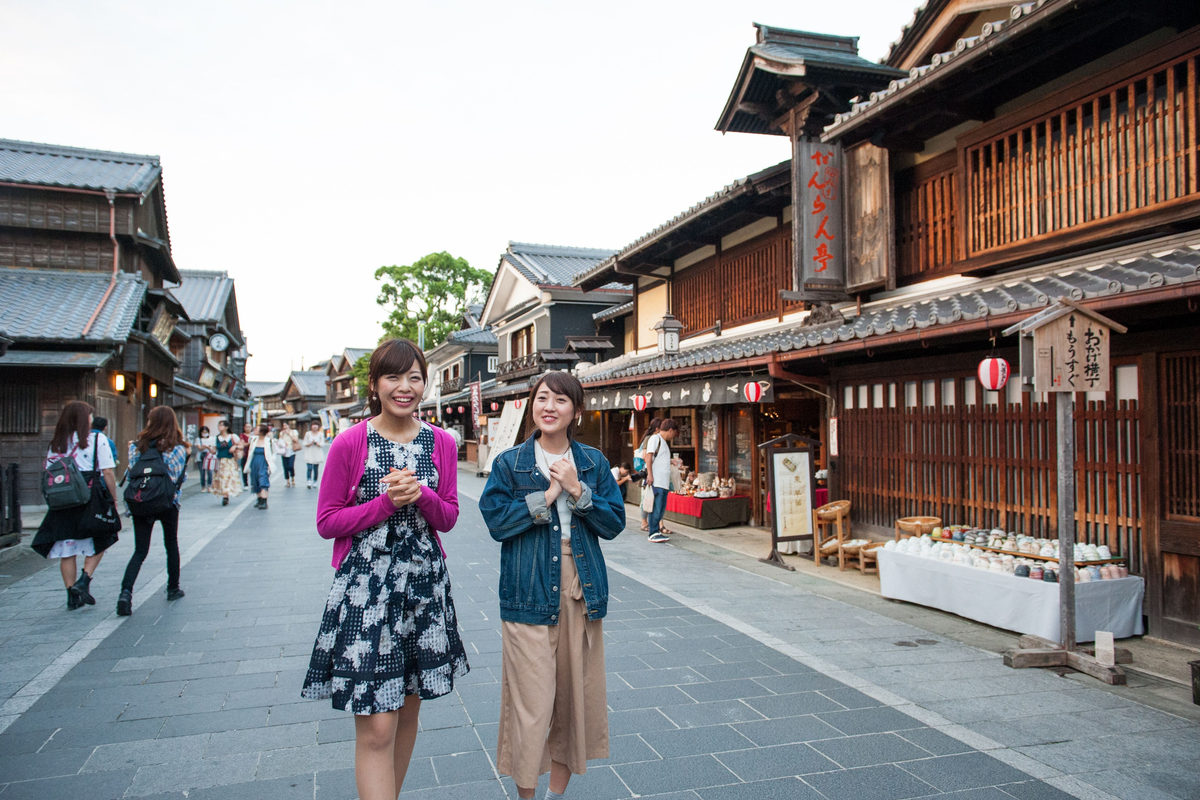
On a trip through Japan you will visit one or the other almost every day. Learn how to tell them apart and what to do there, and the same scenery starts to look completely different.
Contents
- One country, two faiths side by side
- The way to tell them apart is at the entrance
- How to pay your respects, and where shrines and temples differ
- The water pavilion, and why the ladle never touches your lips
- How much to put in the offering box
- The thousand years when gods and buddhas lived together
- Why New Year’s means the shrine and funerals mean the temple
- Nobody will scold you for getting it wrong
- Frequently asked questions
One country, two faiths side by side
Walk around Japan and you will keep running into two kinds of places: ones marked by a red gate, and ones fronted by a large tiled-roof gate. The first is a shrine, meaning a Shinto site; the second is a temple, a Buddhist one. Japan has roughly 80,000 shrines and about 77,000 temples. For scale, the whole country has about 56,000 convenience stores, so places of worship outnumber the konbini. A travel day when you see neither is actually the rare one.
Shinto is Japan’s homegrown faith. It has no founder and no scripture in the sense of the Bible or the Quran. The kami, the gods of Shinto, are believed to dwell in mountains, huge rocks, great trees, waterfalls and ancestors. Kami are almost never represented by statues, and the doors of a shrine’s main sanctuary generally stay closed. In other words, at a shrine you cannot see the object of worship. Buddhism, by contrast, arrived in the 6th century by way of the Korean peninsula: it has a founder (the Buddha), a vast body of sutras, and a system built around rebirth and enlightenment. That is why temples have Buddhist statues, and why worshippers press their palms together right in front of them.
The North American instinct says that if two religions share one country, people must pick a side. Japan never did. Many people visit a shrine at New Year’s, tend the family grave at a temple during the Obon season, and get married in a chapel-style wedding hall. In surveys, more than half of Japanese call themselves non-religious. Yet New Year’s visits to shrines and temples draw on the order of 90 million people every year. It looks like a contradiction, but the honest answer is that 1,400 years of history settled into this shape. As a traveler, you are under no obligation whatsoever to judge which side is right.
The way to tell them apart is at the entrance
The most reliable marker is the entrance. A torii gate means a shrine; a roofed gate with pillars (a sanmon) means a temple. A torii is two posts with crossbeams, a boundary marker announcing that the realm of the kami begins here. A sanmon is a gate that is itself a building, sometimes with a pair of fierce Nio guardian statues inside. There are plenty of other clues.
| What to look at | Shrine | Temple |
|---|---|---|
| Entrance | Torii gate | Sanmon or Nio gate |
| Central building | Honden (sanctuary) and haiden (worship hall) | Hondo or kondo (main hall) |
| Object of worship | A kami. No statue, and the doors stay closed | A Buddhist statue, right in front of you |
| Who works there | Shinto priests (kannushi) and shrine maidens (miko) | Buddhist monks (soryo) |
| Clapping | Yes: two bows, two claps, one bow | No. Palms together only |
| What you sound | A bell (suzu) on a thick rope | A waniguchi gong or the temple bell |
| Smell | Almost none | Usually incense smoke in the air |
| Graves | As a rule, none | On or next to the grounds |
| Name endings | -jinja (神社), -taisha (大社), -gu (宮), -jingu (神宮) | -ji (寺), -in (院), -san (山), -do (堂) |
If in doubt, remembering just two things, torii and clapping, is enough. That said, there really are temples with torii and shrines with five-story pagodas. The history section further down explains why.
How to pay your respects, and where shrines and temples differ
At a shrine
- Bow lightly in front of the torii before you pass through. Take your hat off.
- Keep off the center of the approach path. The middle, called the seichu, is regarded as the path the kami walk. Staying to either side is all it takes.
- Purify your hands and mouth at the temizuya (手水舎) water pavilion. The steps are in the next section.
- Stand in front of the offering box and place your coin in gently. No throwing.
- If there is a bell, ring it. A light shake of the thick rope is enough to sound it.
- Two bows, two claps, one bow. Bow deeply twice, clap twice at chest height, pray silently with your hands still together, then bow deeply once more. This is the standard form nationwide.
- On the way out, once you have passed the torii, turn back toward the sanctuary and bow once.
There are exceptions. Izumo Taisha (Shimane) and Usa Jingu (Oita) use two bows, four claps, one bow. Signs will tell you, and so will watching the people around you. With no line, the whole thing takes a minute or two. There are no rules about what to pray for, and no need to say anything aloud. Many Japanese silently state their name and address before making a request, but even that is optional.
No clapping at a temple
Here is where visitors most often slip. Do not clap at a temple. Clapping is Shinto etiquette; Buddhism does not use it. You simply press your palms together at your chest (gassho).
- Put your palms together and bow at the sanmon gate, then step over the threshold rather than on it as you enter.
- If there is a water pavilion, purify your hands.
- If there is a large incense burner called a jokoro, you can offer a stick of incense and fan the smoke toward whatever part of your body needs mending. Sticks cost about ¥50–100, usually paid into an unattended box.
- In front of the main hall, put your offering in quietly, and if there is a waniguchi gong, sound it with the rope.
- Press your palms together at your chest, bow your head, and pray. No sound. If you carry a Buddhist rosary, hang it on your left hand. Not having one is completely fine.
- Bow once and step back. Bow again toward the hall when you leave through the sanmon.
Details vary by school, but for a traveler only two lines matter: do not clap, and keep quiet.
The water pavilion, and why the ladle never touches your lips
The water basin near the entrance is the temizuya. Shrine or temple, the procedure is nearly identical, and the proper form finishes everything with a single ladleful of water.
- Take the ladle in your right hand, scoop water, and pour it over your left hand.
- Switch the ladle to your left hand and pour over your right hand.
- Take it in your right hand again, pour water into your cupped left palm, and rinse your mouth from your palm. Do not swallow. Cover your mouth and spit discreetly at your feet.
- Rinse your left hand once more.
- Tip the ladle upright so the remaining water runs down and rinses the handle, then set it back face down.
The two absolute do-nots: putting your lips on the ladle, and plunging your hands into the basin. Since 2020 a growing number of shrines and temples have removed the ladles altogether and simply let water flow from bamboo pipes; in that case, rinsing your hands is all that is asked. On winter mornings the water is cold enough to sting, so brace yourself.
How much to put in the offering box
The short answer: there is no rule. Around ¥100 is plenty. Japanese people do like to choose coins for their puns, though, and knowing the game makes it a little more fun.
| Amount | Wordplay | Meaning |
|---|---|---|
| ¥5 | goen (ご縁), which sounds exactly like the word for good ties | The favorite. May good connections come your way |
| ¥45 | shiju goen, meaning good ties from start to finish | May the connection last and last |
| ¥125 | juni-bun ni goen, or good ties in more than full measure | Made with one ¥100 coin and five ¥5 coins |
| ¥10 | toen, distant ties | Some avoid it: it hints that the connection drifts away |
| ¥500 | no koka above it, and koka means both coin and effect | Avoided by some for the same reason, though most people do not worry about it |
All of this is wordplay, not doctrine. If you do not have a ¥5 coin, there is no need whatsoever to make change for one. What actually matters is how you put the coin in: drop it gently, never hurl it. If you offer a bill, the polite form is an envelope rather than a folded note, but no one expects that of a traveler. If you want coins on hand anyway, Japanese vending machines and coin lockers take them too, so keeping a few ¥100 and ¥5 coins in your wallet is simply convenient.
The thousand years when gods and buddhas lived together
This article has drawn a clean line between shrines and temples, but that line only became official in 1868, barely 150 years ago.
After Buddhism arrived in the 6th century, the Japanese did not pit the two faiths against each other. They blended them. This is called shinbutsu shugo, the fusion of kami and buddhas. Temples (jingu-ji) went up on shrine grounds, and monks chanted sutras before the kami. In the Heian period, the honji suijaku theory spread. It held that Japan’s kami were forms the buddhas had taken in order to save the people of this land, and the correspondences were mapped out in detail: the kami of the Kumano mountains, for instance, as manifestations of Amida Buddha. The word gongen (avatar) was born from exactly this line of thought.
Then in 1868 the Meiji government issued the Separation Edict and pried shrines and temples apart by force. The policy was designed to place Shinto at the center of an emperor-led state. It set off haibutsu kishaku, a wave of anti-Buddhist destruction in which vast numbers of statues, ritual objects, and sutras were lost. The five-story pagoda of Kofuku-ji in Nara famously came close to being sold off for a pittance.
That is why, even today, you find pagoda foundations on shrine grounds and torii still standing inside temples. The five-story pagoda at Nikko Toshogu, the pagoda and Senjokaku hall right beside Itsukushima Shrine, and the Kumano Kodo itself, a pilgrimage road threading shrines and temples together, are all remnants of those thousand mixed years. The institutions were separated; the landscape, and the way faith is actually felt, never quite were.
Why New Year’s means the shrine and funerals mean the temple
Nothing in Japanese religious behavior confuses foreign visitors more than this division of labor. The reason lies in history.
Shinto treats death as impurity to be kept at a distance. That is why shrine grounds have no graves, and why the custom lingers that people in mourning stay away from torii for a while. Buddhism, on the other hand, came equipped with a system of rebirth and the world to come. It was Buddhism that had an answer ready for the question of what to do about death.
The decisive step was the Edo-period danka system. To stamp out Christianity, the shogunate required every household to register with a temple. Temples took on a role something like a civil registry, and monopolized funerals and ancestral rites. After 250 years of this, the double structure had set hard: the family religion is Buddhist, the neighborhood festival is Shinto.
So Japanese go to the shrine at New Year’s because a fresh year belongs to the side of life, and hold funerals at temples because that is the side in charge of death. It is not a change of faith. It is a division of roles. Most Japanese carry it out as second nature, without being able to explain the logic themselves.
Nobody will scold you for getting it wrong
After all that detail, here is the honest truth: it is extremely rare for anyone to be scolded over etiquette. Japanese people themselves miscount their claps, skip the water pavilion, and stride down the middle of the approach in numbers. A foreign traveler visibly trying to do things properly is almost always received with warmth. There is no need to be tense.
That said, please avoid the following. These touch the line that makes it a place of faith.
- Follow no-photography signs. The interiors of sanctuaries, Buddhist statues, and treasure halls are often off-limits, and tripods and selfie sticks are banned in more and more places.
- Do not cut in front of someone praying. Leave the space in front of the offering box clear and pass behind.
- Do not photograph priests, monks, or worshippers’ faces without permission, above all during festivals and services.
- No loud voices, no running, no eating or drinking. The grounds are not a park.
- Do not touch sacred trees or statues. Statues meant to be touched (nade-botoke) are marked as such.
- Do not sit on offering boxes or climb torii. Both have become real problems in recent years.
- Do not wander through graveyards hunting photos. Those are other families’ graves.
Dress is up to you. Shorts and sandals are fine. But where you step up into a main hall you will take your shoes off, so slip-on footwear and socks without holes are worth having. Most shrines charge no admission; at famous temples the main hall runs ¥300–600 and special openings around ¥1,000, as of August 2026.
Frequently asked questions
I am Christian, or not religious at all. Is it OK for me to take part?
Completely. Japanese shrines and temples ask no conversion and no membership of their visitors. Think of putting your hands together not as a confession of faith but as a gesture of respect toward the place, and there is no conflict. If you would rather not, standing quietly and giving a single bow is not the least bit rude.
Which should I prioritize, shrines or temples?
If architecture, gardens, and Buddhist sculpture are what draw you, temples pack in more, especially in Kyoto and Nara. If you want the air of the forest, the approach path, the feel of the land, shrines are your side. At places like Ise Jingu and Kumano, the approach itself, not the buildings, is the main event. Put one of each into a day and the contrast teaches you more than either alone.
How much do admission fees add up to?
As of August 2026: most shrine grounds are free, with treasure halls at ¥300–800. Temples charge ¥300–600 for the main hall and gardens: Kiyomizu-dera around ¥400, Kinkaku-ji around ¥500. Hit five or six sites in a Kyoto day and admissions alone reach ¥2,000–3,000. Many ticket windows are still cash only, so carry coins.
Will tattoos keep me out?
Being turned away from a shrine or temple over tattoos is almost unheard of. Where restrictions bite is onsen and pools, and we have laid that out in our article on tattoos and onsen.
Is there information in English?
The famous sites in the major destinations of Kyoto, Nara, Nikko and Kamakura have English pamphlets and signboards in good order. Small rural shrines and temples are Japanese-only as a rule. For an itinerary built around your interests, reach us via contact us. Articles on other themes are listed in the travel guide.

Plan this trip with IACE
Everything in this article is knowledge we use in real bookings every day. Tell us your dates, group size and interests, and we will turn it directly into your own itinerary.